Effects of high-intensity interval training on cognitive flexibility among female teenagers
DOI:
https://doi.org/10.52567/trehabj.v8i01.54Keywords:
cognitive flexibility, digital span test, high intensity exercises, mini mental state examinationAbstract
Background: Teenage is an important stage for brain development, with significant impacts on education and health. Exploring how high-intensity interval training (HIIT) affects cognitive function in this population is crucial to comprehending how HIIT can improve general well-being and academic performance.
Objective: To determine the effects of high-intensity interval training on cognitive flexibility among female teenagers.
Methodology: A randomized clinical trial was conducted on n=40 female participants between 13-19 years without any serious medical, physical, or psychological illness for 6 months. All participants (n=40) were randomly divided into experimental (HIIT) and control groups equally. The protocols were performed in 4 mins in the first three weeks, 8 mins in the 4th to 6th week, and 12 mins in the 7th and 8th week, with sessions thrice a week. Data on cognitive flexibility was collected at baseline, after 4th week and 8th week from both groups through Digit Span (DST).
Results: With-in-group analysis the experimental group showed significant improvement (p<0.001) at each level of assessment of DST (forward and backward) till the 8th-week session with a large effect size whereas the non-significant improvement (p≥0.05) was observed in the control group. For Group Analysis, significant results (p<0.001) were obtained in the experimental group for DST (forward and backward) after the 4th week and at the end of intervention after the 8th week as compared to the control group.
Conclusion: It is concluded that the high-intensity exercise training program is beneficial for female teenagers to enhance their physical strengthening along with their cognitive abilities.
Clinicaltrials.gov Identifier: NCT05873478
INTRODUCTION
Cognitive flexibility is the ability to adapt one's cognitive processing strategies to new and unexpected environmental situations. [1, 2]. Automating skills is the primary objective of most skill training programs to expedite performance and free up cognitive resources for other task demands. Automation of skill can, however, be linked to cognitive rigidity and mistakes in performance[3, 4]. Different training programs have therefore been put forth to address performance issues brought on by automation and high-interval training programs help to achieve automation with the best results among different training programs [5].
Enhancing cognitive function has positive benefits on the body and mind of women since it is linked to increased resistance training and physical activity levels [6]. The higher incidence of mental health problems that manifest in adolescence may also be attributed to the loss of physical activity. It has been proposed that girls' cognitive performance may be enhanced by completing a high-intensity interval training program[7].
For both athletic and general/recreational populations, high-intensity interval training is currently highly advised, with the main goal being the improvement of aerobic power[8] To improve young people's physical health, high-intensity interval training (HIIT) has become a viable and effective approach [9, 10]. Vigorous-intensity exercise enhances cognition more than moderate- and light-intensity exercise, according to recent systematic evaluations conducted on school-aged kids [11].
Females show lacking in verbal communication, perceptual or thinking speed, accuracy, and fine motor skills. In terms of assertiveness, stress tolerance, and self-esteem or confidence, men tend to score higher than women. This shows that emotional intelligence may be a factor in the gender gap in leadership. In the workplace, these distinctions frequently favor men and disadvantage women [12].
As physical fitness levels are associated with improved cognitive performance[6] and there is limited literature on high-intensity interval training for female teenagers for improving cognition between the age group of 13 to 19 years. Therefore, this study aims to evaluate the effect of 8 weeks of high-intensity interval training on cognitive flexibility in female teenagers in a specific age group to overcome deficits further.
METHODOLOGY
Study Design: A randomized clinical trial (NCT05873478) was conducted at the Royal Institute of Physiotherapy and Rehabilitation Sciences (RIPRS/20220716-1), Hidayat campus Sukkur, Pakistan, for a time duration of 6 months from July 2022 to December 2023. The study was initially approved by the research and ethical committee (REC) of Riphah International University, Islamabad (Riphah/RCRS/REC/Letter-01497). Written informed consent was taken from the students as well as from their parents before the study.
Participants: the inclusion criteria were teenage females (13 to 19 years of age) without any serious medical illness whereas those with physical or psychological illness were excluded from the study.
Sample Size: Using G power, a sample size of n=40 was determined, with an α error margin of 0.05 and a small effect size of 0.25. To mitigate the risk of β mistake, a power (1-β) of 0.93% was chosen. The participants were randomly divided into two groups i.e., the Experimental group (n=20) and the Control group (n=20) (Figure 1).
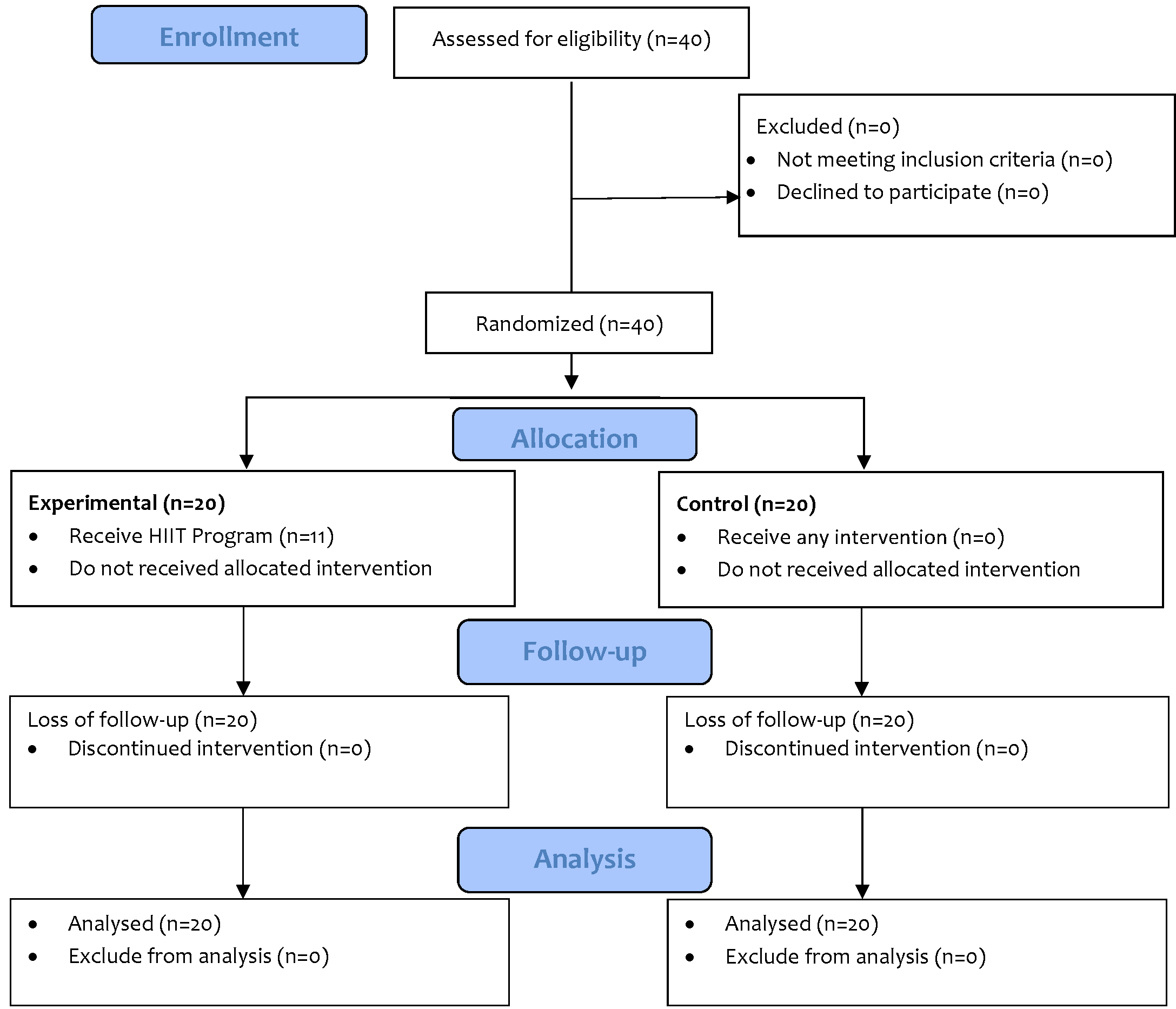
Figure 1: CONSORT Diagram
Randomization: Using the sealed envelope approach, a computerized random number generator was used to randomly choose the participants. A person not directly involved in the study completed the random assignment sequence. Before the investigation, sequential random numbers were written on index cards and put in thick, opaque sealed envelopes. After getting approval from the participants' legal guardians or next of kin, the treating physiotherapist opened the envelope and administered the appropriate intervention to the patient. The evaluating physiotherapist was unaware of the participant's intervention, so the trial was single-blinded.
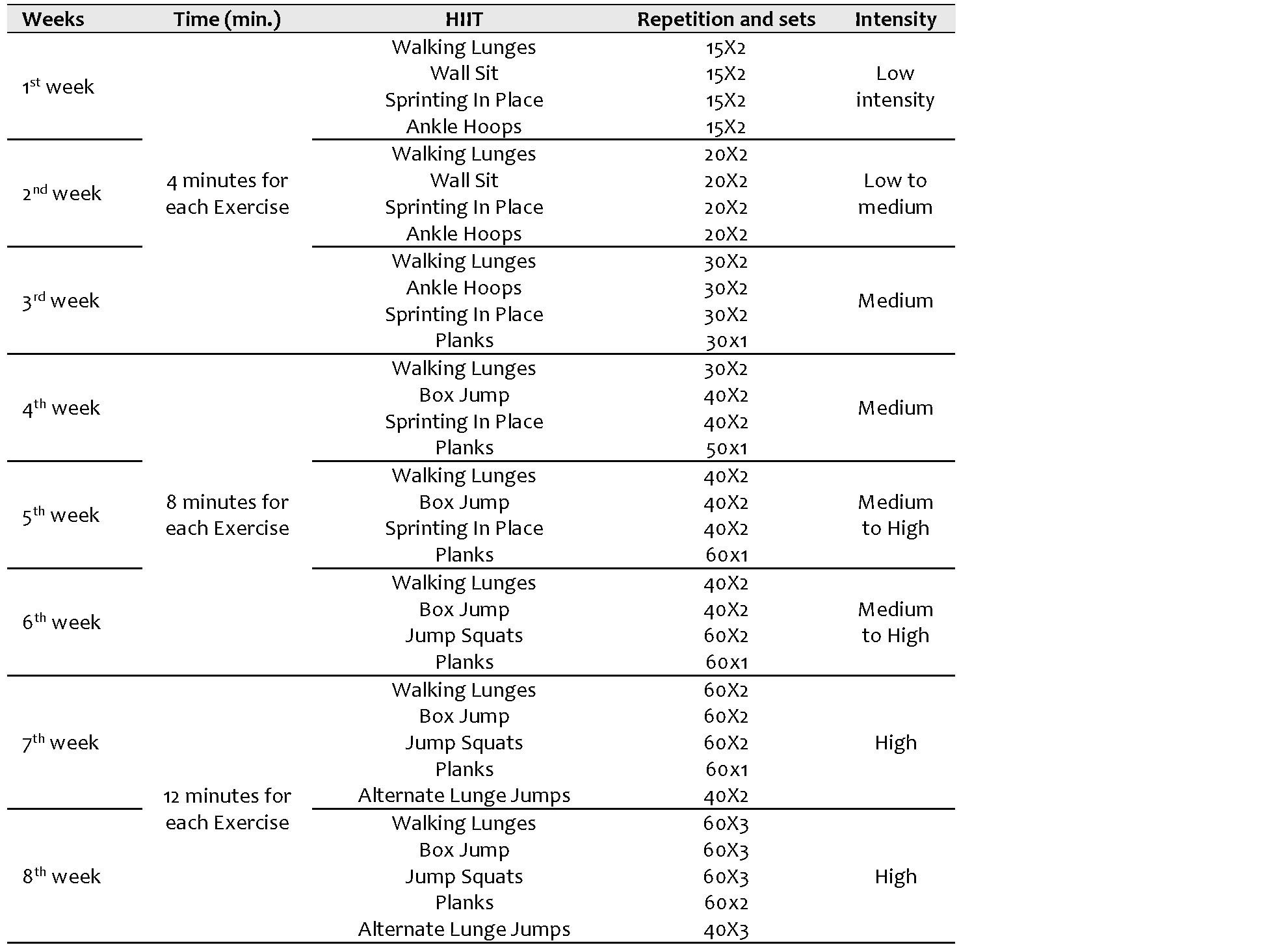
Intervention: The HIIT sessions ranged from 4-12 minutes in duration for 8 weeks in which three sessions were conducted each week (weeks 1-3: 4 minutes; weeks 4-6: 8 minutes; weeks 7-8: 12 minutes respectively), with a work to rest ratio of 30sec: 10sec, as mentioned in table 1. The experimental group/HIT group engaged in their HIIT sessions (inclusive of a short warm-up activity including dynamic exercises i.e., walking/running, 8-10 minutes of HIIT, and cool down which includes static exercises i.e., shoulder and hip muscle stretches). Session duration and intensity were increased with weekly progression in intervention groups. The high-resistance training sessions were delivered by the researcher to the HIT group, as mentioned in Table 1
Experimental Group: High-Intensity Interval Training (HIIT): Participants complete HIIT sessions that include bodyweight resistance training exercises (e.g., walking lunges, walk sit, sprinting in place, planks, and jumping jacks & skipping, etc). For example, the HIIT work phase includes the following sequence of resistance exercises (30-second walking lunges, 10-second rest then 30-second sprinting in place, 10-second rest & 30-second planks, 10-second rest intervals, etc.) All the exercises as mentioned in Table 1, were performed by the participant beginning with low-intensity exercise and then progressing to high-intensity training from week 1 to week 8, in this pattern repetition and sets increase every week, with 10-sec rest duration required after every set and proper warm up and cool down is mandatory for every session. Progression in repetition sets in every week with 10-sec rest after every session, 10 minutes warm up & cool down following 3 sessions per week
Control Group: Participants in the control group were not bound to do any specific activity; they all were engaged in normal daily routines.
Table 1: Detail Intervention Protocol (High-intensity training)
Outcome Measures: Digit Span (DST) was used for the assessment of female teenagers’ cognition during training. Digit Span (DGS) is a measure of verbal short-term and working memory that can be used in two formats, Forward Digit Span and Reverse Digit Span. This is a verbal task, with stimuli presented auditory, and responses spoken by the participant and interpreted accordingly [13]. Reliable Digit Span Cutoff Scores of ≤7 and ≤6 From the Personal Database show 90% and 88% specificity in 10 to 12 years of age [14].
Statistics: For the interaction effects, mixed ANOVA was analyzed. the main effects were measured through Repeated measures ANOVA for with-in-group changes along with pairwise comparison and independent t-test used for between the group differences in the DST score. The data was analyzed by using SPSS version 21. The p<0.05 was considered statistically significant.
RESULTS
A total of n=40 female teenage participants with the Mean age was 17.37±.89 years. All participants were in the normal BMI range with a mean BMI of 20.10±0.99 kg/m2.
As the sphericity was not assumed, the Greenhouse-Geisser values showed that there is a significant interaction effect between interventions and time factor for DST (Forward) {F= 140.26(1.72,64.68), p<0.001, ɳp2=.787} as well as for DST (Backward) {F= 54.59(1.38,52.63), p<0.001, ɳp2=0.59}. (Figure 2)
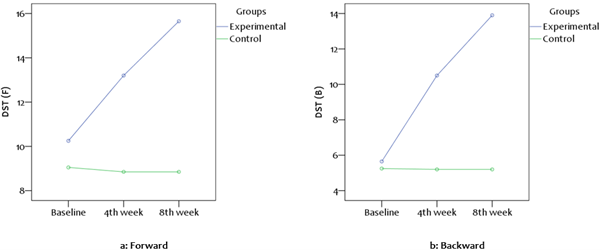
Figure 2: Interaction Effect Between Intervention and Time Factor
In the With-in group analysis, the experimental group showed significant improvement (p<0.001) at each level of assessment of DST (forward and backward) till the 8th-week session with a large effect size whereas the non-significant improvement (p≥0.05) has observed in the control group. (Table 2)
Table 2: Repeated Measure (Within Group) For DST
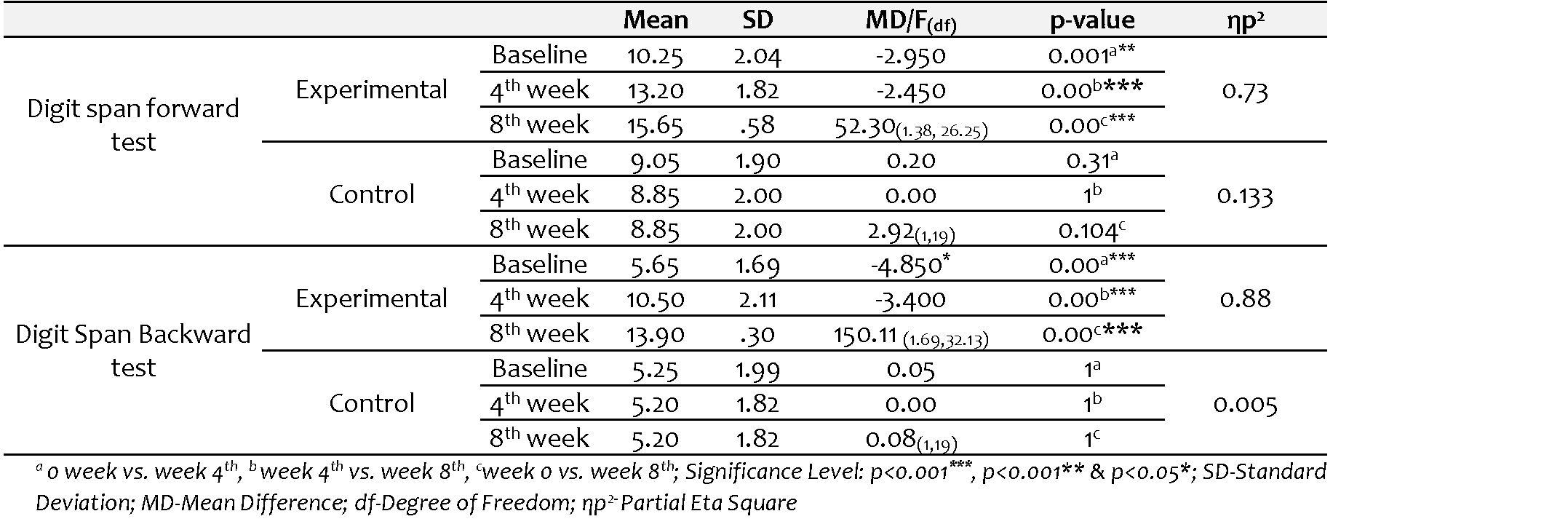
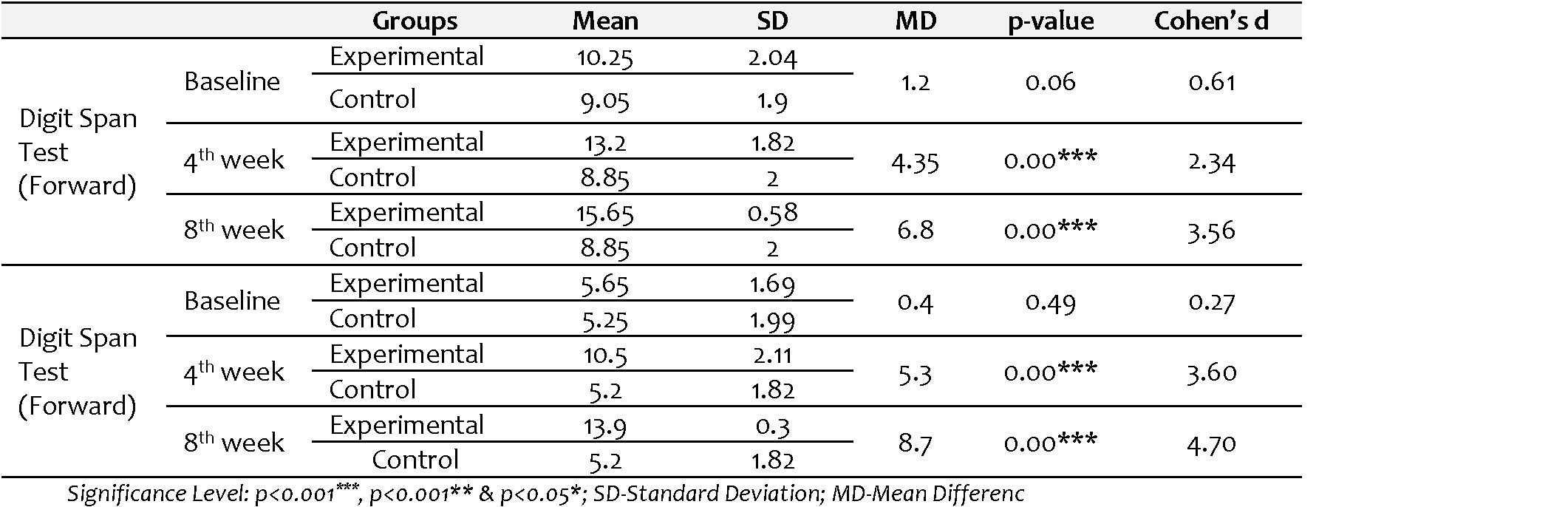
For Group Analysis, an independent t-test was run and significant results (p<0.001) were obtained in the experimental group for DST (forward and backward) after the 4th week and at the end of the intervention after the 8th week as compared to the control group. (table 3)
Table 3: Independent t-test between the groups for DST
DISCUSSION
The current study examined the effects of high-intensity interval training (HIIT) performed for 8 weeks on cognitive flexibility performance among female teenagers belonging to the age range 13 to 19 years. The data showed how HIIT significantly enhanced cognitive flexibility, which was based on the result of the digit span test (DST), and that a control group engaged in regular daily routines had lower scores. This evidence suggests that HIIT can be a good method of enriching the cognitive function of females during adolescence.
Evidence indicates that regular physical activity and high-intensity interval training improve physical strengthening and corresponding improvements in cardiopulmonary physical fitness that result in an increase in cerebral perfusion and vasoreactivity across the human lifespan. The betterment of cerebral perfusion leads to better cognitive ability and mental health [15].
The study's results further support the previous status on the benefits of physical activity to brain health [16]. HIIT, in which young people do efficient exercise and jogging for small periods and then have little time for rest, makes a positive impact on aerobic fitness and physical health outcomes in youth. This research, by coincidence, extends the findings of cognitive flexibility which is a key aspect of cognitive functions as a kind of problem-solving situation.
The breakthrough regarding cognitive flexibility that was detected in the youth population is very remarkable [17]. Throughout the teenage years, the brain functions grow and mature. Therefore, interventions that provide cognitive improvement in this period, can turn up to be lifelong improvements that shape academic performance and general sensitivity. The research's results show that HIIT might be considered an effective way of keeping an adolescent's brain functional.
It is still unknown how working out in intervals helps the cognitive function of the brain; possible effects could be changes in the brain structure and function. Evidence supports the existence of neurotrophic factors, for example, brain-derived neurotrophic factors, which are commonly referred to as BDNF, one of the factors that contribute heavily to the growth and survival of nerve cells [18, 19]. HIIT may also stimulate cerebrovascular functions, thus increasing blood flow and oxygen supply to the brain which is represented as necessary elite cognitive functioning [20].
The mental health was observed by evaluation of the level of alertness in the questionnaire and significant improvements were observed in the mental health of the female participants in the current study. Similar results were obtained by the researcher who conducted research on the adults and school-going students to check the effectiveness of the moderate and high-intensity exercise training program and concluded that better results were observed on the young(school-going) population and significant results were obtained in the high-intensity exercise training program [21]. Mental health and cognitive ability were also observed by the current study by using a digital span test that comprised a set of figures that had to be repeated in the forward (forward digital span test) and in the back (backward digital span test). Consistent results were obtained in the study conducted on the teenager to evaluate the level of memory improvements and the author revealed that those who are involved in any physical activity like sports or other training programs have better memory and show significant improvement over time [22].
The interaction effect between the two groups (Experimental and Control) of the current study revealed that the Greenhouse Geisser values showed that there is a significant interaction effect between interventions and time factor/assessment in all domains of the Digital Span Test (forward) as p>0.05 and non-significant for the Digital Span Test (backward) as p>0.05. The results were consistent with the study conducted by Suda S who used a mini-mental state questionnaire to evaluate the level of mental health of the participants of acute stroke who followed the exercise training program of 10 weeks [23].
There are a few limitations to the present study. Firstly, the values are recorded solemnly on the effectiveness of the training program provided to the subjects. Several confounding factors like stress, physical activity, and physical health were not maintained. Secondly, the short-term effects were observed in the enrolled population. Moreover, the duration of the training program was standardized irrespective of the participant’s mental ability i.e., both scruffy and smart female teenagers received the same set and intensity of training which can affect the outcome variables.
CONCLUSION
The high-intensity exercise training program is beneficial for female teenagers to enhance their cognitive abilities along with physical strengthening. It also helps teenagers to increase their mental health for better health and memory.
The long course of interventional treatment should be monitored with a large sample size to generalize the results with a better understanding. Confounding factors like the performance of physical activity, stress level, and physical health issues that can delay the outcomes of interventional therapy should be considered.
DECLARATIONS & STATEMENTS
Author’s Contribution
NJ: substantial contributions to the conception and design of the study.
NJ, SK, and AT: acquisition of data for the study.
HA: analysis of the data for the study.
NJ, HA, and MAMA: interpretation of data for the study.
BS and QI: drafted the work.
NJ, MAMA, SK, AT, HA, BS, and QI: revised it critically for important intellectual content.
NJ, MAMA, SK, AT, HA, BS, and QI: final approval of the version to be published and agreement to be accountable for all aspects of the work in ensuring that questions related to the accuracy or integrity of any part of the work are appropriately investigated and resolved. All authors contributed to the article and approved the submitted version.
Ethical Statement
The study was initially approved by the research and ethical committee (REC) of Riphah International University, Islamabad (Riphah/RCRS/REC/Letter-01497). It was conducted at the Royal Institute of Physiotherapy and Rehabilitation Sciences (RIPRS/20220716-1), Hidayat campus Sukkur, Pakistan.
Consent Statement
Written informed consent was obtained from participants as well as from the caregivers to participate in the study.
Data Availability Statement
The data that support the findings of this study are available on request from the corresponding author. The data is not publicly available due to privacy or ethical restrictions.
Acknowledgments
Thanks to the participants of this study for sharing their personal experiences with pain.
Conflicts of Interest
The authors declare no conflict of interest.
Funding
The authors declare that no funds, grants, or other support were received during the conduction of research and preparation of this manuscript.
REFERENCES
- Guthold R, Stevens GA, Riley LM, Bull FC. Worldwide trends in insufficient physical activity from 2001 to 2016: a pooled analysis of 358 population-based surveys with 1·9 million participants. Lancet Glob Health. 2018; 6(10):e1077-e1086. . [CrossRef] [PubMed]
- Brockmann AN, Ross KM. Bidirectional association between stress and physical activity in adults with overweight and obesity. J Behav Med. 2020;43(2):246-53. [CrossRef] [PubMed]
- Frazier S, Pitts BJ, McComb S. Measuring cognitive workload in automated knowledge work environments: a systematic literature review. Cogn Technol Work. 2022;24(4):557-87. [CrossRef]
- Immink MA, Verwey WB, Wright DL. The neural basis of cognitive efficiency in motor skill performance from early learning to automatic stages. In: Nam CS, editor. Neuroergonomics: Principles and Practice. Cham: Springer International Publishing; 2020. p. 221-49. [CrossRef]
- Shimada H, Makizako H, Doi T, Park H, Tsutsumimoto K, Verghese J, et al. Effects of combined physical and cognitive exercises on cognition and mobility in patients with mild cognitive impairment: A randomized clinical trial. J Am Med Dir Assoc. 2018;19(7):584-591. [CrossRef] [PubMed]
- Shepherd V. An exploration around peer support for secondary pupils in Scotland with experience of self-harm. Educational Psychology in Practice. 2020;36(3):297-312. [CrossRef]
- Rothon C, Edwards P, Bhui K, Viner RM, Taylor S, Stansfeld SA. Physical activity and depressive symptoms in adolescents: a prospective study. BMC Med. 2010 28;8:32. [CrossRef] [PubMed]
- Ahmadi A, Arastoo AA, Nikbakht M, Zahednejad S, Rajabpour M. Comparison of the effect of 8 weeks aerobic and yoga training on ambulatory function, fatigue and mood status in MS patients. Iran Red Crescent Med J. 2013;1 15(6):449-54. [CrossRef] [PubMed]
- Chastin SF, De Craemer M, De Cocker K, Powell L, Van Cauwenberg J, Dall P, et al. How is light-intensity physical activity associated with adult cardiometabolic health and mortality? Systematic review with meta-analysis of experimental and observational studies. Br J Sports Med. 2019;53(6):370-6. [CrossRef] [PubMed]
- Toots A, Littbrand H, Lindelöf N, Wiklund R, Holmberg H, Nordström P, et al. Effects of a high‐intensity functional exercise program on dependence in activities of daily living and balance in older adults with dementia. J Am Geriatr Soc. 2016;64(1):55-64. [CrossRef]
- Love R, Adams J, van Sluijs EM. Are school-based physical activity interventions effective and equitable? A meta-analysis of cluster randomized controlled trials with accelerometer-assessed activity. Obes Rev. 2019;20(6):859-70. [CrossRef] [PubMed]
- Ghrouz AK, Noohu MM, Manzar D, Warren Spence D, BaHammam AS, Pandi-Perumal SR. Physical activity and sleep quality about mental health among college students. Sleep Breath. 2019 Jun;23(2):627-634.. [CrossRef] [PubMed]
- Zhidong C, Wang X, Yin J, Song D, Chen Z. Effects of physical exercise on working memory in older adults: a systematic and meta-analytic review. Eur Rev Aging Phys Act. 2021;18(1):18.. [CrossRef] [PubMed]
- Webber TA, Critchfield EA, Soble JR. Convergent, discriminant, and concurrent validity of nonmemory-based performance validity tests. Assessment. 2020;27(7):1399-415. [CrossRef] [PubMed]
- Calverley TA, Ogoh S, Marley CJ, Steggall M, Marchi N, Brassard P, et al. HIITing the brain with exercise: mechanisms, consequences, and practical recommendations. J Physiol. 2020;598(13):2513-30. [CrossRef] [PubMed]
- Reyes-Amigo T, Bezerra A, Gomez-Mazorra M, Boppre G, Martins C, Carrasco-Beltran H, et al. Effects of high-intensity interval training on executive functions in children and adolescents: A Systematic Review and Meta-analysis. Phys Act Rev. 2022;10(2). [CrossRef]
- Mekari S, Neyedli HF, Fraser S, O’Brien MW, Martins R, Evans K, et al. High-intensity interval training improves cognitive flexibility in older adults. Brain Sci. 2020;10(11):796. [CrossRef] [PubMed]
- Mekari S, Earle M, Martins R, Drisdelle S, Killen M, Bouffard-Levasseur V, et al. Effect of high-intensity interval training compared to continuous training on cognitive performance in young healthy adults: a pilot study. Brain Sci 2020;10(2):81. [CrossRef] [PubMed]
- Mou H, Tian S, Yuan Y, Sun D, Qiu F. Effect of acute exercise on cognitive flexibility: Role of baseline cognitive performance. Mental Health and Physical Activity. 2023;25:100522. [CrossRef]
- Ángel Latorre-Román P, Berrios-Aguayo B, Aragón-Vela J, Pantoja-Vallejo A. Effects of a 10-week active recess program in school setting on physical fitness, school aptitudes, creativity and cognitive flexibility in elementary school children. A randomized-controlled trial. J Sports Sci. 2021;39(11):1277-86. [CrossRef] [PubMed]
- Janssen I, LeBlanc AG. A systematic review of the health benefits of physical activity and fitness in school-aged children and youth. Int J Behav Nutr Phys Act. 2010;7(1):1-16. [CrossRef]
- Ahmed SF, Ellis A, Ward KP, Chaku N, Davis-Kean PE. Working memory development from early childhood to adolescence using two nationally representative samples. Dev Psychol. 2022;58(10):1962-1973. [CrossRef] [PubMed]
- Lande MB, Kupferman JC. Blood pressure and cognitive function in children and adolescents. Hypertension. 2019;73(3):532-40. [CrossRef] [PubMed]

Submitted
Accepted
Published
How to Cite
Issue
Section
License
Copyright (c) 2024 Nazia Jabbar, Samra Khokhar, Amna Toseef, Humera Ayub , Bibi Masooma, Qainat Iqbal

This work is licensed under a Creative Commons Attribution 4.0 International License.
Authors retain copyright and grant the journal right of first publication and allows others to share the work with an acknowledgment of the work’s authorship and initial publication in this journal. No use, distribution or reproduction is permitted which does not comply with these terms.