Effectiveness of kettle bell workout on abdominal muscles strength In recreational athletes: a randomized controlled trial
DOI:
https://doi.org/10.52567/trehabj.v9i01.99Keywords:
abdominal strength, core stability, Kettlebell training, recreational athletesAbstract
Background: Recreational athletes often lack access to specialized strength training as kettlebell workouts on abdominal muscle strength can provide valuable insights
Objective: to determine the effectiveness of a Kettlebell training program in improving abdominal muscle strength among recreational athletes.
Method: A RCT was conducted on n=40 recreational athletes without history of neuromuscular injury in the last six months. Participants were randomly assigned into two Experimental Group (n=20) engaged in kettlebell training and Control Group (n=20) maintained their usual routine without any structured fitness training Abdominal strength was measured before and after the 12-week period using a seven-stage abdominal muscle strength test. Data were analyzed using SPSS software.
Result: The mean age of 21.73±1.78 years and Body Mass Index (BMI) was 20.18±0.68 kg/m². The between-group comparison at post-test revealed a statistically significant difference (p=0.007), with a moderate effect size (r=0.425), indicating that the Kettlebell training had a meaningful impact on abdominal muscle strength.
Conclusion: The study indicates that Kettlebell training is an effective method for improving abdominal muscle strength.
INTRODUCTION
Core strength is a fundamental component of physical fitness, athletic performance, and injury prevention. The abdominal muscles play a central role in core stability, contributing to posture maintenance, balance, force generation, and reducing the risk of musculoskeletal injuries[1]. Strengthening these muscles will enhance functional movement patterns and athletic capabilities[2].
Traditional core strengthening programs typically involve exercises such as sit-ups, planks, and resistance machine-based workouts, like crunches, leg raises, and planks are commonly prescribed to target the abdominal muscles[3]. A study highlights the effectiveness of isometric and dynamic core exercises in improving abdominal muscle endurance and strength. However, these exercises often focus on isolated muscle activation rather than functionally engaging multiple kinetic chains [4].
In recent years, strength training methodologies have evolved to emphasize dynamic and functional movements, with kettlebell training emerging as a popular modality due to its ability to engage multiple muscle groups simultaneously[5]. Kettlebell workouts incorporate ballistic and isometric movements that challenge core stability, coordination, and muscular endurance. Such as kettlebell swings, Turkish get-ups, and windmills are frequently incorporated into training routines for their perceived benefits in core activation, but their direct impact on abdominal muscle strength remains underexplored[6, 7].
Existing studies suggest that kettlebell training activates the posterior chain and core muscles due to the explosive hip hinge movement demonstrated that kettlebell training improved back and core endurance in working adults, implying potential benefits for abdominal strength[5, 8]. Similarly, it was found that kettlebell swings generate significant core activation due to the demands of trunk stabilization[9]. However, while these studies support the involvement of the core in kettlebell training, there is limited empirical evidence specifically assessing its effectiveness in strengthening the abdominal muscles compared to traditional core exercises[10].
Most previous research has focused on general fitness improvements, with an emphasis on core endurance rather than absolute strength measures. Furthermore, randomized controlled trials (RCTs) directly comparing kettlebell workouts with conventional abdominal strengthening exercises remain scarce. This study aims to bridge this gap by investigating the effects of a structured kettlebell training program on abdominal muscle strength in recreational athletes from various sports. By comparing the outcomes of kettlebell exercises with conventional core strengthening routines, this study will provide valuable insights for fitness professionals, athletes, and rehabilitation specialists seeking optimal strategies for abdominal strength development.
METHODOLOGY
Study Design and Setting: A parallel-group, pre-test, and post-test experimental design was implemented. The study was conducted at the I-8 Active Gym located in I-8 Markaz, Islamabad, Pakistan, for a duration of 12 weeks. Ethical approval was obtained from the Board of Studies, Project Evaluation Committee (PEC), Institutional Review Board (IRB # 905-IV-A), and the Board of Advanced Studies and Research (BASR) at the University of Lahore, Pakistan.
Participants: A total of n=40 healthy recreational athletes from various sports disciplines were recruited for this study. Eligibility criteria included individuals with no neuromuscular injury in the last six months. The participants having recent musculoskeletal injury or pain were excluded from the study.
Sample size: The required sample size per group, calculated using G*Power with an effect size of 0.8, an alpha level of 0.05, and a power of 0.86, is approximately n=20 participants per group. This results in a total sample size of n=40 participants for the study. The Participants were randomly assigned into two Experimental Groups (n=20) engaged in kettlebell training and the Control Group (n=20) maintained their usual routine without any structured fitness training. (Figure 1)
Randomization and blinding: Random allocation was performed using a computer-generated randomization sequence. Allocation concealment was maintained by employing sealed opaque envelopes. Due to the nature of the intervention, blinding of participants was not feasible. However, assessors responsible for outcome measurements were blinded to group allocations.
Intervention: The kettlebell training program was designed to follow a structured 12-week plan with a 1:2 work-to-rest ratio. Participants attended training sessions twice weekly, leading to a total of 24 sessions. Each session lasted approximately 45 ± 10 minutes. Each exercise lasted 25 seconds, followed by 50 seconds of rest. To allow for recovery between different exercises, a 2-minute break was provided when switching movements. The workout included five key kettlebell exercises: the kettlebell deadlift, two-handed kettlebell swing, kettlebell clean, one-arm kettlebell snatch, and front squat with a jump. Each exercise was performed for five sets, maintaining a consistent rhythm of work and rest. Participants started with a 12 kg kettlebell for the first four weeks before progressing to an 18 kg kettlebell for the remaining eight weeks. This gradual increase in weight helped build strength and endurance over time. Throughout the program, the structure remained the same ensuring uniformity in sets, exercise duration, and rest periods, so participants could focus on steady improvement without unnecessary variation. The control group maintained their usual routine without any structured fitness training.
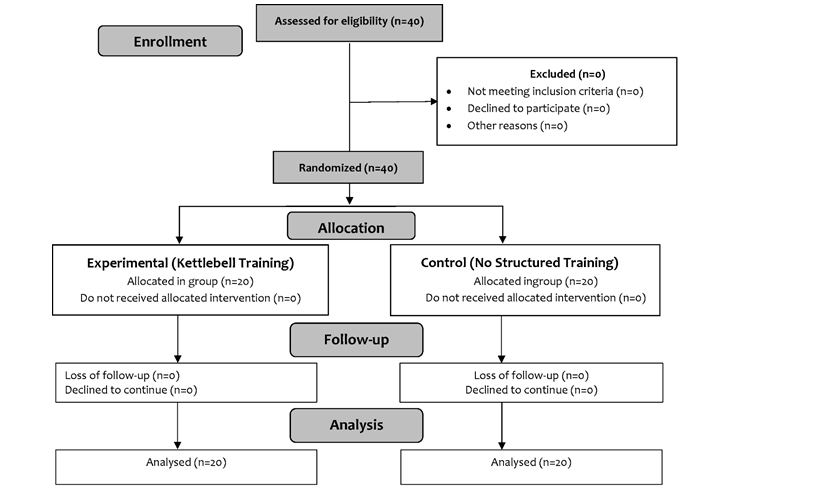
Figure 1: CONSORT diagram
Outcome Measures: The Seven-Stage Abdominal Strength Test is a standardized assessment used to evaluate abdominal muscle strength. It is a progressive test consisting of seven levels, each increasing in difficulty. All assessments were conducted one week before and one week after the intervention to ensure consistency.
Statistical Analysis: Data analysis was performed using SPSS software. Descriptive statistics (means and standard deviations) were used to summarize participant characteristics and outcomes. As the abdominal strength was measured on a 7-stages ordinal scale, a non-parametric, Mann Whitney U test was applied to see group differences, while Wilcoxon sign ranked test was applied for within-group analysis. The median, interquartile range, and mean rank were used as descriptive statistics. To determine the effect size correlation (r) was used, and the level of significance was set at p<0.05 using SPSS version 26.
RESULTS
The descriptive statistics for the participant (n=40) indicate that ages range from 19 -25 years, with a mean age of 21.73±1.78 years. The participant's Body Mass Index (BMI) varies between 18.55 and 21.65, with an average BMI of 20.18±0.68 kg/m².
At the pre-test score both groups were comparable at the baseline (p = 0.899), Th post-intervention, the Kettlebell group demonstrated an increase in abdominal muscle strength (M=3, IQR= 2.0-4.0, MR of 25.35), whereas the Control group had a median score of M=2, IQR=1.0-3.0) and a lower MR of 15.65. The between-group comparison at post-test revealed a statistically significant difference (p=0.007), with a moderate effect size (r=0.425), indicating that the Kettlebell training had a meaningful impact on abdominal muscle strength. Within-group analysis showed a significant improvement in the Kettlebell group from pre-post (p<0.001), whereas no significant (p=0.317) change was observed in the Control group. (table 1)
Table 1: Within-Between group analysis of abdominal muscle strength

DISCUSSION
This study adds significant insight to the ongoing discussion around functional strength training by showing that kettlebell workouts can genuinely improve abdominal muscle strength in recreational athletes. The results revealed a statistically significant gain in abdominal strength in those who participated in the kettlebell training, with a moderate effect size (r=0.425), supporting the idea that this form of exercise has practical benefits for core development.
Unlike traditional core exercises that typically isolate muscle groups like crunches or planks, kettlebell movements are more dynamic. They involve multiple joints and planes of motion, which help to build trunk stability, coordination, and neuromuscular control[3, 11]. Exercises such as kettlebell swings cleans, and snatches incorporate explosive, full-body movements that actively challenge the core, making them particularly suitable for athletes involved in fast-paced, high-intensity sports[7].
While earlier research has acknowledged kettlebell training’s role in enhancing overall core endurance and engaging the posterior chain, not many studies have specifically looked at its impact on abdominal strength using a randomized controlled approach [7, 12]. This study helps fill that gap by offering concrete evidence that kettlebell training, even over a relatively short period, can lead to measurable improvements in abdominal strength when compared to structured training. The use of the Seven-Stage Abdominal Strength Test, a reliable and progressive tool, further adds to the validity of these findings.
Our results, aligned with previous research, demonstrate the benefits of Kettlebell training on abdominal strength. Jay et al. (2013) reported significant improvements in abdominal strength and endurance following a six-week Kettlebell program, incorporating exercises such as swings, Turkish get-ups, and windmills[13]. Similarly, Wilson et al. (2015) found that Kettlebell exercises, including the snatch and windmill, activated core muscles more effectively than traditional exercises like crunches and planks[14]. Lake et al. (2017) observed enhanced abdominal strength and power in collegiate athletes after integrating Kettlebell training into their regimen[15]. While Layon et al (2017) highlighted the high levels of abdominal muscle activation during Kettlebell swings and cleans[16].
There are some limitations to consider. The study didn’t compare kettlebell training with traditional core workouts like planks or sit-ups, so we can’t say for sure whether it’s more effective than those methods. Also, with only 40 participants and a 12-week timeframe, it’s possible that longer-term effects or sport-specific adaptations weren’t fully captured.
CONCLUSION
The study indicates that Kettlebell training is an effective method for improving abdominal muscle strength. It can recommend as a valuable component of strength and conditioning programs for individuals aiming to improve core stability and overall physical performance. Future research should explore gender-based variations to optimize its benefits further.
DECLARATIONS & STATEMENTS
Author’s Contribution
The following format should be used for author’s contribution.
IU and DR: substantial contributions to the conception and design of the study.
IU and A: acquisition of data for the study.
IU, NA and NU: interpretation of data for the study.
LQ: analysis of the data for the study.
IU and AS: drafted the work.
IU, A, NA, NU, DR and LQ: revised it critically for important intellectual content.
IU, A, NA, NU, DR and LQ: final approval of the version to be published and agreement to be accountable for all aspects.
of the work in ensuring that questions related to the accuracy or integrity of any part of the work are appropriately investigated and resolved. All authors contributed to the article and approved the submitted version.
Ethical Statement
The study was conducted after approval from Institutional Review Board (IRB # 905-IV-A) at the University of Lahore, Pakistan.
Consent Statement
Informed consent was obtained from all subjects involved in the study.
Data Availability Statement
Further data can be available on request.
Acknowledgments
We would like to acknowledge Mr Armaghan Khalid for facilitating the data collection at I-8 Active Gym Islamabad.
Conflicts of Interest
The authors declare no conflict of interest.
Funding
The funders had no role in the design of the study; in the collection, analyses, or interpretation of data; in the writing of the manuscript; or in the decision to publish the results.
REFERENCES
- Ma S, Geok Soh K, Binti Japar S, Xu S, Zhicheng G. Maximizing the performance of badminton athletes through core strength training: Unlocking their full potential using machine learning (ML) modeling. Heliyon. 2024;10(15):e35145. [CrossRef] [PubMed]
- Dong K, Yu T, Chun B. Effects of core training on sport-specific performance of athletes: a meta-analysis of randomized controlled trials. Behav Sci (Basel). 2023;13(2). [CrossRef] [PubMed]
- Oliva-Lozano JM, Muyor JM. Core muscle activity during physical fitness exercises: a systematic review. Int J Environ Res Public Health. 2020;17(12). [CrossRef] [PubMed]
- Örgün E, Kurt C, Özsu İ. The effect of static and dynamic core exercises on dynamic balance, spinal stability, and hip mobility in female office workers. Turk J Phys Med Rehabil. 2020;66(3):271-80. [CrossRef] [PubMed]
- Govindasamy K, Gogoi H, Jebabli N, Bediri SM, Aljahni M, Parpa K, et al. The effects of kettlebell training versus resistance training using the own body mass on physical fitness and physiological adaptations in obese adults: a randomized controlled trial. BMC Sports Sci Med Rehabil. 2024;16(1):106. [CrossRef] [PubMed]
- Meigh NJ, Keogh JWL, Schram B, Hing WA. Kettlebell training in clinical practice: a scoping review. BMC Sports Sci Med Rehabil. 2019;11:19. [CrossRef] [PubMed]
- Jaiswal PR, Ramteke SU, Shedge S. Enhancing Athletic Performance: a comprehensive review on kettlebell training. Cureus. 2024;16(2):e53497. [CrossRef] [PubMed]
- Hanney WJ, Perez A, Collado G, Palmer AC, Wilson AT, Richardson RM, et al. The immediate effects of a standardized kettlebell swing protocol on lumbar paraspinal muscle function: a randomized controlled trial. J Strength Cond Res. 2024;38(11):1854-9. [CrossRef] [PubMed]
- Meigh NJ, Keogh JWL, Schram B, Hing W, Rathbone EN. Effects of supervised high-intensity hardstyle kettlebell training on grip strength and health-related physical fitness in insufficiently active older adults: the BELL pragmatic controlled trial. BMC Geriatr. 2022;22(1):354. [CrossRef] [PubMed]
- Meigh NJ, Hing WA, Schram B, Keogh JWL. Force profile of the two-handed hardstyle kettlebell swing performed by an RKC-certified instructor. 2021:2021.05.13.444085. [CrossRef]
- van den Tillaar R, Saeterbakken AH. Comparison of core muscle activation between a prone bridge and 6-rm back squats. J Hum Kinet. 2018;62:43-53. [CrossRef] [PubMed]
- Leong CH, Forsythe C, Bohling Z. Posterior chain and core training improves pelvic posture, hamstrings-to-quadriceps ratio, and vertical jump performance. J Sports Med Phys Fitness. 2024;64(1):7-15. [CrossRef] [PubMed]
- Jay K, Jakobsen MD, Sundstrup E, Skotte JH, Jørgensen MB, Andersen CH, et al. Effects of kettlebell training on postural coordination and jump performance: a randomized controlled trial. J Strength Cond Res. 2013;27(5):1202-9. [CrossRef] [PubMed]
- Wilson JM, Duncan NM, Marin PJ, Brown LE, Loenneke JP, Wilson SM, et al. Meta-analysis of postactivation potentiation and power: effects of conditioning activity, volume, gender, rest periods, and training status. J Strength Cond Res. 2013;27(3):854-9. [CrossRef] [PubMed]
- Lake JP, Lauder MA. Kettlebell swing training improves maximal and explosive strength. J Strength Cond Res. 2012;26(8):2228-33. [CrossRef] [PubMed]
- Lyons BC, Mayo JJ, Tucker WS, Wax B, Hendrix RC. Electromyographical comparison of muscle activation patterns across three commonly performed kettlebell exercises. J Strength Cond Res. 2017;31(9):2363-70. [CrossRef] [PubMed]

Submitted
Accepted
Published
How to Cite
Issue
Section
License
Copyright (c) 2025 Ismat Ullah, Amna, Natasha Amjad, Naseer Ullah, Danish Rauf, Liao Qin

This work is licensed under a Creative Commons Attribution 4.0 International License.
Authors retain copyright and grant the journal right of first publication and allows others to share the work with an acknowledgment of the work’s authorship and initial publication in this journal. No use, distribution or reproduction is permitted which does not comply with these terms.