Factors affecting the speech intelligibility of children with hearing impairment
DOI:
https://doi.org/10.52567/trehabj.v8i02.61Keywords:
hearing aid, hearing impairment', speech intelligibilityAbstract
Background: Children with hearing impairment have difficulties affecting their ability to understand speech and general communication development. It is essential to understand the background of the factors affecting young children's speech intelligibility in the Pakistani setting.
Objective: To explore the factors affecting speech intelligibility among children with hearing impairment.
Methods: A total of n=107 individuals were selected for the 6-month study at GMT clinic, Siemens Hearing Clinic, Hearing and Speech Care Clinic, and RHS in Islamabad using non-probability convenience sampling. Children between the ages of 6 and 12 who had mild to profound sensorineural hearing loss and could express themselves at the phrase level met the inclusion criteria. Speech-impairing conditions and progressive or conductive hearing loss were included in the exclusion criteria. Using the Assessing Intelligibility Worksheet, data was collected, in which 17 utterances with 57 words spoken by the therapist participants were repeated and the responses were noted by the therapist. Multiple linear regression, descriptive statistics, and percentage distribution were all analyzed using SPSS 21.
Results: A multiple regression model was run to predict intelligibility utterance from age, gender, type of hearing aid, technology of hearing aid, degrees of hearing loss, and talkativeness. This model significantly predicted speech intelligibility of hearing aid users {F (8, 98) = 42.905, p<0.001}. All variables cause 77.8% (Adj. R2=.778) variance in speech intelligibility of hearing aid users.
Conclusion: The study concludes that there is a considerable impact of gender, the technology of hearing aids, degree of hearing loss, and talkativeness level on speech intelligibility while no significant impact of types of hearing aids concerning Behind the ear and receiver in the canal on children's speech intelligibility.
INTRODUCTION
Hearing loss (HL) in infancy and early childhood is a well-established factor contributing to suboptimal speech and language development. By impeding a child's access to speech and language input, varying from minimal in cases of mild HL to nearly complete in severe to profound HL, it adversely affects speech and language development [1]. Speech intelligibility is the capacity of a person to comprehend speech [2, 3]. Affecting Speech Intelligibility is articulation, childhood apraxia of speech, dysarthria, speech sound disorders, stuttering, background noise, and hearing [4].
There is a well-established relationship between speech intelligibility and hearing impairment. Hearing impairment can affect an individual's ability to perceive sounds, particularly high-frequency sounds, which are important for speech perception. As a result, individuals with hearing impairment may have trouble understanding speech, particularly in noisy or reverberant environments [5,6]. Additionally, as hearing impairment severity increased, speech intelligibility scores decreased further. The relationship between hearing impairment and speech intelligibility is also influenced by other factors, such as age, cognitive abilities, and language proficiency [7,8]. Therefore, early identification and intervention for hearing impairment are crucial to improving speech intelligibility and overall communication ability even in profound hearing loss [9, 10,11].
The impact of HL on their communication abilities, primarily in spoken language, can lead to heightened difficulties in establishing positive relationships with hearing peers [12]. A prevalent consequence of hearing loss, affecting approximately 10% of the population, is a diminished ability to comprehend speech in the presence of background noise, particularly nonstationary noises [13]. Speech intelligibility in people with hearing impairments is affected by several variables, including talkativeness, auditory training, emotional state, environmental context, hearing aid type and technology, and degree of hearing loss [14, 15]. While digital and Receiver-In-Canal (RIC) aids improve clarity, severe hearing loss impairs speech perception [16]. Speech comprehension is enhanced through social engagement and auditory rehabilitation. Important roles are also played by cognitive abilities and environmental elements like background noise [17]. Better outcomes are correlated with positive emotional states [18, 19].
There is a dearth of thorough research on the complex factors influencing the speech intelligibility of children with hearing impairment among children in Pakistan. Prior research frequently concentrates on discrete elements, like the effectiveness of assistive technology or the accessibility of speech therapy, failing to provide a comprehensive understanding of the interplay between multiple variables. Furthermore, little is known about the prevalence of early detection and the influence of socioeconomic status on the availability and caliber of services related to hearing rehabilitation for children. Targeted interventions can be developed with an understanding of how factors such as talkativeness, age, gender, type of aid, technology, and degree of hearing loss affect speech intelligibility. So, the objective of the studies is to explore the factors affecting speech intelligibility among children with hearing impairment.
MATERIALS AND METHODS
Study Design: The Cross-sectional analytical study was conducted after permission from competent authorities of Siemens Hearing Clinic (SHC/Ref-2023/10-1) Islamabad, Hearing and Speech Care Clinic (R. No-HSCC/1206) Rawalpindi and RHS (No: RHS/EC/02-06-2023-01) in Islamabad. The duration of the study was 6 months from July 2023 to December 2023, after the ethical approval.
Selection Criteria: The participants were clinically diagnosed with sensorineural hearing loss as shown by their Pure Tone Audiometry from mild to profound degree of hearing loss, their age ranging from 6 to 12 years of both genders, and they were using hearing aids and having phrase level Expression. The participants with Progressive hearing loss, Conductive hearing loss, Children with otitis media, any other disability affecting the speech, and Unilateral hearing loss.
Sample Size: The required sample size (n=107) was calculated through priori analysis for multiple linear regression. In which effect size was kept at 0.15, the probability of the alpha error was 0,05, power 80%, and total number of predictors was 12.
Outcome Measure: Assessing Intelligibility Worksheet was used to assess and test the degree of intelligibility or understandability of spoken language The worksheet's methodical design evaluates various facets of intelligibility, assisting professionals in learning more about a person's or a group's capacity for efficient speech communication. The worksheet was designed for the children to assess their speech intelligibility having 17 utterances with 57 words. After that, the formula was applied to the acquired data (intelligible words/ total words X 100) same as well, for the utterance's intelligibility (intelligible utterances/ total utterances X 100). If a child scores <70% intelligibility he or she might pass. It means that his device working accurately according to the need.
Data Collection Procedure: The study used non-probability Convenience sampling to collect children with hearing impairment after obtaining written informed consent from their parents. The data was collected from the participants using an Assessing Intelligibility worksheet, the examiner was seated at a one-armed distance in front of the participants with covered faces and the responses were noted on phrase level expression by 17 utterances with 57 words spoken by the therapist and participants were listening and were repeating the listen utterances and the responses were written by the therapist.
Data Analysis: Data was analyzed descriptively by mean and standard deviation and graphically presented using a bar chart showing frequencies and percentages. The Multiple Linear regression test was applied to determine the impact of different factors on the speech intelligibility of children. For multiple linear regression, categorical variables were converted to dummy variables with a regression algorithm requiring numerical input to process the variables. The test was applied through SPSS version 22, and the level of significance was set at α=0.05
RESULTS
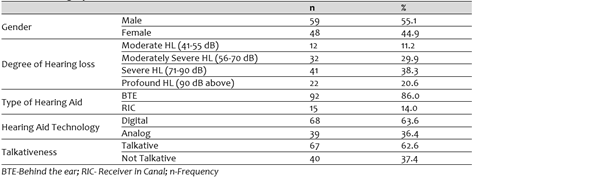
The mean age of the n=107 study participants was 10.1308±1.83176 years. A total of n=59 (55.14%) was male and the remaining n=48 (44.86%) were females. Other demographic characteristics have been reported in Table 1.
Table 1: Demographic Distribution
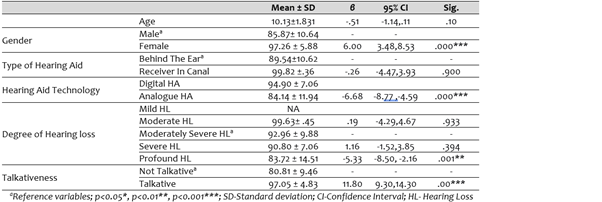
A multiple regression model was run to predict intelligibility means from age, gender, type of hearing aid, technology of hearing aid, degrees of hearing loss, and talkativeness. This model significantly predicted speech intelligibility of hearing aid users {F (8, 98) = 45.788, p<0.001}. All variables cause 77.2% (Adj. R2=.772) variance in speech intelligibility of hearing aid users. Individually, Speech intelligibility mean was not significantly impacted by age, type of hearing aid, and moderate and severe hearing loss. While gender, talkativeness level, and technology of hearing aid showed significant results, on the other hand, degree of hearing loss shows important results in moderately severe hearing loss and profound hearing loss as compared to different types of hearing loss (Moderate and Severe HL) which showed no significance. (Table 2)
Table 2: Factors Predicting the Total Intelligibility Score
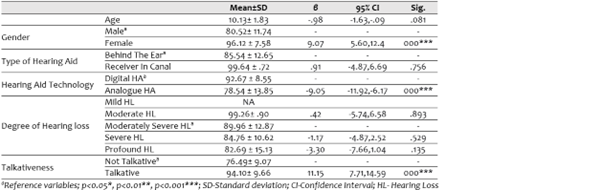
A multiple regression model was run to predict intelligibility words from age, gender, type of hearing aid, technology of hearing aid, degrees of hearing loss, and talkativeness. This model significantly predicted speech intelligibility of hearing aid users {F (8, 98) = 32.961, p<0.001}. All variables cause 70.7% (Adj. R2=.707) variance in speech intelligibility of hearing aid users. Individually, Speech intelligibility of words was not significantly impacted by age or type of hearing aid (p<0.05). While gender, talkativeness level, and technology of hearing aid showed significant results, on the other hand, the degree of hearing loss showed consequences resulting in moderately severe hearing loss as compared to different types of hearing loss (Moderate, Severe, and Profound HL) which showed no significance. (Table 3)
Table 3: Factors Predicting the Word Intelligibility
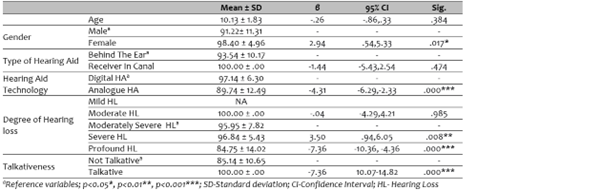
A multiple regression model was run to predict intelligibility utterance from age, gender, type of hearing aid, technology of hearing aid, degrees of hearing loss, and talkativeness. This model significantly predicted speech intelligibility of hearing aid users {F (8, 98) = 42.905, p<0.001}. All variables cause 77.8% (Adj. R2=.778) variance in speech intelligibility of hearing aid users. Individually, Speech intelligibility of utterance was not significantly impacted by age or type of hearing aid (p<0.05). While gender, talkativeness level, and technology of hearing aid showed significant results, however the degree of hearing loss showed no significant result in moderate hearing loss as compared to other types of hearing loss (Moderately Severe, Severe, and Profound HL) which showed significant results. (Table 4)
Table 4: Factors Predicting the Intelligibility Utterances
DISCUSSION
The study's results, which sought to predict speech intelligibility among varied users of hearing aids, show a complex link between several variables and speech comprehension. The study shows that speech intelligibility would be greatly impacted by talkativeness, age, gender, kind of hearing aid, and technology. The results show that some characteristics are quite important in predicting speech intelligibility, but other ones might not have a big impact [20].
According to various hearing aid users' speech intelligibility may not be significantly predicted by age. This result defies some of the material that has been published thus far, which suggests that age plays a significant role in speech perception. It is intriguing and deserves more investigation. The absence of a statistically significant impact of age may be due to a few factors, including the study's particular techniques, sample size, and participant inclusion requirements. Developmental, cognitive, and environmental factors play a complex role in the relationship between age and speech intelligibility in children wearing hearing aids. Speech perception is impacted by the development of the auditory system, which is modified by early exposure and skill acquisition. Variations are influenced by linguistic exposure, vocabulary growth, and levels of cognitive and linguistic maturity. The efficacy of hearing aids is affected by age-related changes in adaptation. Speech understanding is impacted by age-related changes in social interactions and communication abilities. Understanding individual variances is essential to comprehending speech intelligibility in this heterogeneous population, including the degree of hearing loss and the effectiveness of the intervention [21].
Second, the study highlights that the type of hearing aid worn may not have a major impact on speech intelligibility. This result contradicts some earlier studies that emphasize how important it is to select the appropriate hearing aid to improve communication outcomes. It raises questions about the effectiveness of different assistive listening technologies and the need for therapies specific to a person's characteristics. Choosing between Behind-the-Ear (BTE) and Receiver-in-Canal (RIC) hearing aids has a significant impact on children's comprehension of speech [22]. BTE devices' larger size and more potent components make them useful for those with severe to profound hearing loss.
On the other hand, smaller, inside-the-ear devices called RIC aids offer natural sound quality for mild to moderate hearing loss. To BTE aids, which could be more sensitive to feedback and pain, thus impairing intelligibility, RIC aids reduce feedback challenges and are simpler to maintain. Children may find certain RIC aids are more aesthetically beautiful and handy, so it's crucial to take their needs and tastes into account when selecting the appropriate kind of hearing aid [23].
It's also remarkable that some degrees of hearing loss did not significantly predict speech intelligibility. This contradicts the widely held belief that a higher degree of hearing loss is correlated with a lower ability to perceive speech. The subtle differences in how speech intelligibility and hearing loss relate to each other highlight how intricate auditory processing is and how much more research is needed to fully comprehend individuals with variances[24]
Positively, talkativeness, gender, and hearing aid technology are all important predictors of speech intelligibility across various hearing aid users, according to the study. These results concur with previous research indicating that these variables are critical to the communication outcomes experienced by those having hearing loss [25].
According to research showing the benefits of digital technology, children who use digital hearing aids have greater anticipated speech intelligibility than those who use analogue devices. Signal processing is where digital aids shine; they can successfully separate speech from background noise. Their programmability and adaptability allow customized amplification for different hearing profiles, improving voice recognition. Digital aids work better than analogues under listening settings because they incorporate sophisticated noise reduction, feedback management, dynamic range compression, and speech processing algorithms. Many audiology investigations have confirmed this trend, representing a major progress in meeting the auditory demands of people with hearing loss and improving speech intelligibility [26].
According to the current study, children with profound and moderately severe hearing loss can perceive speech better when their hearing aids are adjusted properly. Conventional hearing aids and advanced features like cochlear implants' direct auditory nerve stimulation enhance speech comprehension. Sophisticated speech coding techniques maximize the transmission of important speech cues in hearing aids. Children with significant hearing loss benefit from early exposure to language-rich environments and access to communication therapies showing language development. Notwithstanding general trends, individual variability influenced by things like early intervention and cognitive processing highlights the significance of tailored strategies for achieving the best results in speech intelligibility [27].
According to a recent study, talkative children get greater auditory stimulation from verbal conversations, which may improve their auditory processing and speech intelligibility. Their engaged involvement in discussions offers regular language exposure and speech practice chances, which build up understanding and output. Improved speech intelligibility may also be influenced by engaging children's strong social engagement and communication skills. An active motivation to wear hearing aids improves optimal auditory input. Parental and educational support for advanced language development expands vocabulary and improves language structures, which enhances total speech intelligibility [28].
Age-related influences on word and utterance intelligibility in children wearing hearing aids include auditory development, vocabulary growth, language acquisition, experience, cognitive processing, hearing aid adaption, and intervention services. While older kids benefit from more developed cognitive skills and linguistic repertoires, younger kids could still be in the early phases of auditory and language development. Improved intelligibility can be attributed to hearing aid adaption and rich language exposure over time. The outcomes are further influenced by individual differences, the quality of the intervention, and the features of the hearing aids. This highlights the need for ongoing research in pediatric audiology to improve therapies for children at different developmental stages [1].
Gender and word/utterance intelligibility in children wearing hearing aids have a complicated and poorly understood relationship. Variations in language development, social and communication styles, cultural influences, educational approaches, socioemotional factors, hearing aid usage habits, and biological factors are a few possible causes. These factors influenced by individual variances within genders, probably work together to produce the observed discrepancies. To improve outcomes for both boys and girls with hearing impairment, further research is necessary to identify the precise mechanisms underlying gender-related disparities in speech intelligibility and to inform customized therapies [29].
The lack of statistically significant results in predicting word and utterance intelligibility among children based on hearing aid types (BTE and RIC) could be attributed to shared technological characteristics, the focus on customized fittings, different adaptation strategies, and possible differences in regular use. The nuanced findings are influenced by various factors, including technological developments, limited sample sizes, outcome measurements, and testing settings. Differences between each type of hearing aid may potentially be masked by heterogeneity. Future studies should examine characteristics and personal preferences to have a deeper understanding of how the type of hearing aid affects speaking outcomes in children who wear them [30].
The substantial influence that digital aids have on children's word and utterance intelligibility can be attributed to their advanced signal processing, flexibility, noise reduction, feedback control, dynamic range compression, and speech processing algorithms that are prioritized. Personalized fits, which guarantee a customized strategy based on lifestyle and hearing impairment considerations, enhance intelligibility. Digital hearing aids are more successful than analogue ones according to aiding children's speech understanding because of their consistent sound quality and continuous technical developments [31].
Children with moderately severe hearing loss, using hearing aids, exhibit superior word intelligibility compared to those with moderate, severe, and profound hearing loss. This aligns with literature-supported factors: enhanced audibility, advanced signal processing, communication interventions, individual variability, developmental advantages, and the influence of social and educational support. The complexity of hearing loss, coupled with technological advancements and contextual nuances in intervention, underscores the need for a comprehensive understanding of factors contributing to divergent word intelligibility outcomes in children with varying degrees of hearing loss [32].
Children with extensive to moderately severe hearing loss who wear hearing aids had better speech intelligibility than children with mild hearing loss. Better auditory development, effective management of speech perception problems, advanced speech coding techniques, individual variances, improved communication accessibility, targeted intervention, and potential contributions from social and educational dynamics are all consistent. The realization of the intricate interactions between these components emphasizes the need for individualized knowledge and interventions to maximize utterance intelligibility in children with varying hearing profiles. This complexity of hearing loss outcomes in using hearing aids is reinforced [33].
Compared to their less talkative counterparts, children who wear hearing aids and are talkative have greater word and utterance intelligibility. Contributing factors include increased motivation and engagement, advanced language development, parental and educational support, improved social interaction and communication skills, increased auditory stimulation, language exposure, and practice. Even if these factors contribute to the observed differences, it's also important to consider individual distinctive features and contextual factors. To have a more complex picture of these dynamics, more study is required to examine the precise processes behind the relationship between talkativeness and speech intelligibility in kids wearing hearing aids[34].
Limitation of the study: The study's limitations were a small sample size for the generalization and the need for attention in the digital hearing aid which should include additional channels or quality.
CONCLUSION
There is a considerable impact of gender, technology of hearing aids, degree of hearing loss, and talkativeness level on speech intelligibility. The optimization of hearing aid technology and support, customized interventions based on the severity of hearing loss, and the promotion of frequent verbal interactions to improve talkativeness and speech practice are all important considerations for interventions aimed at improving speech intelligibility.
It is recommended that we investigate hearing technology more, with a particular focus on the digital hearing aids' channels and other improving features. To enhance generalizability, suggesting repeating the study with a bigger, more varied population.
DECLARATIONS & STATEMENTS
Author’s Contribution
SA and AQA: substantial contributions to the conception and design of the study.
SA, AQA: acquisition of data for the study.
SA: analysis of the data for the study.
SA and AQA: interpretation of data for the study.
SA, FM and HN: drafted the work.
SA, FM, HN and AQA: revised it critically for important intellectual content.
SA, FM, HN and AQA: final approval of the version to be published and agreement to be accountable for all aspects of the work in ensuring that questions related to the accuracy or integrity of any part of the work are appropriately investigated and resolved. All authors contributed to the article and approved the submitted version.
Ethical Statement
The study was conducted with permission from competent authorities of Siemens Hearing Clinic (SHC/Ref-2023/10-1) Islamabad, Hearing and Speech Care Clinic (R. No-HSCC/1206) Rawalpindi and RHS (No:RHS/EC/02-06-2023-01) in Islamabad.
Consent Statement
Informed consent was obtained from parents/guardians of all children involved in the study.
Data Availability Statement
Due to privacy the data presented in this study are available upon request from the corresponding author, as they are not publicly accessible.
Acknowledgments
The authors gratefully acknowledge the assistance and permissions granted by the competent authorities of Siemens Hearing Clinic Islamabad, Hearing and Speech Care Clinic Rawalpindi, and RHS (in Islamabad. This study would not have been possible without their support and cooperation.
Conflicts of Interest
The authors declare no conflict of interest.
Funding
The authors did not receive support from any organization for the submitted work.
REFERENCES
- Walker EA, Holte L, McCreery RW, Spratford M, Page T, Moeller MP. The influence of hearing aid use on outcomes of children with mild hearing loss. J Speech Lang Hear Res. 2015;58(5):1611-25. [CrossRef] [PubMed]
- Heinrich A, Henshaw H, Ferguson MA. The relationship of speech intelligibility with hearing sensitivity, cognition, and perceived hearing difficulties varies for different speech perception tests. Front Psychol. 2015;6:782.[CrossRef] [PubMed]
- Reinhart PN, Souza PE. Intelligibility and clarity of reverberant speech: effects of wide dynamic range compression release time and working memory. J Speech Lang Hear Res. 2016;59(6):1543-54. [CrossRef] [PubMed]
- Acke FR, Dhooge IJ, Malfait F, De Leenheer EM. Hearing impairment in stickler syndrome: a systematic review. Orphanet J Rare Dis. 2012;7:84. [ CrossRef] [PubMed]
- Figueiredo RS, Mendes B, Cavanaugh MC, Novaes B. Hearing loss classification by degree, configuration and relationship with amplified Speech Intelligibility Index (SII). Codas. 2016;28(6):687-96. [CrossRef] [PubMed]
- Camargo N, Mendes BCA, Novaes B. Relationship between hearing capacity and performance on tasks of speech perception in children with hearing loss. Codas. 2020;32(1):e20180139.[CrossRef] [PubMed]
- Hornsby BW. The effects of hearing aid use on listening effort and mental fatigue associated with sustained speech processing demands. Ear Hear. 2013;34(5):523-34. [CrossRef] [PubMed]
- Yahata I, Kawase T, Miyazaki H, Takata Y, Yamauchi D, Nomura K, et al. Factors affecting the variation of maximum speech intelligibility in patients with sensorineural hearing loss other than apparent retrocochlear lesions. Clin Exp Otorhinolaryngol. 2015;8(3):189-93.[CrossRef] [PubMed]
- Lemke U, Scherpiet S. Oral communication in individuals with hearing impairment-considerations regarding attentional, cognitive and social resources. Front Psychol. 2015;6:998. [CrossRef] [PubMed]
- Picou EM, Ricketts TA, Hornsby BW. How hearing aids, background noise, and visual cues influence objective listening effort. Ear Hear. 2013;34(5):e52-64. [CrossRef] [PubMed]
- Sultana N, Butt A Kamal, Khan MSG. Speech intelligibility in hearing aid users with and without auditory training. J Riphah Coll. Rehabili. Sci. 2014.29;2(2):26-32.
- Martin D, Bat-Chava Y, Lalwani A, Waltzman SB. Peer relationships of deaf children with cochlear implants: Predictors of peer entry and peer interaction success. Journal of Deaf Studies and Deaf Education. 2011;16(1):108-20. [CrossRef] [PubMed]
- Dillon H. Hearing aids: Thieme Medical Publishers; 2012. [CrossRef] [PubMed]
- Nordvik Ø. Quality of life in persons with hearing loss: The importance of psychological variables and hearing loss severity. 2020.
- Gillis, Steven. "37. Speech and language in congenitally deaf children with a cochlear implant". Handbook of Communication Disorders: Theoretical, Empirical, and Applied Linguistic Perspectives, edited by ElitzurHG Dattner and Dorit Ravid, Berlin, Boston: De Gruyter Mouton, 2018: 765-792. [CrossRef]
- An YH, Sub Lee E, Hyun Kim D, Sik Oh H, Ho Won J, Joon Shim H. Long-term effects of hearing aid use on auditory spectral discrimination and temporal envelope sensitivity and speech perception in noise. J Int Adv Otol. 2022;18(1):43-50. [CrossRef] [PubMed]
- Stropahl M, Besser J, Launer S. Auditory training supports auditory rehabilitation: a state-of-the-art review. 2020;41(4):697-704. [ CrossRef] [PubMed]
- Ferguson M, Henshaw H. How does auditory training work? Joined-up thinking and listening. Semin Hear. 2015;36(4):237-49. [CrossRef] [PubMed]
- Pichora-Fuller MK, Mick P, Reed M. Hearing, cognition, and healthy aging: social and public health implications of the links between age-related declines in hearing and cognition. Semin Hear. 2015;36(3):122-39.[CrossRef] [PubMed]
- Miles K, Beechey T, Best V, Buchholz J. Measuring speech intelligibility and hearing-aid benefit using everyday conversational sentences in real-world environments. Front Neurosci. 2022;16:789565. [CrossRef] [PubMed]
- Kim BJ, Oh SH. Age-related changes in cognition and speech perception. Korean J Audiol. 2013;17(2):54-8. [CrossRef] [PubMed]
- Tomblin JB, Oleson JJ, Ambrose SE, Walker E, Moeller MP. The influence of hearing aids on the speech and language development of children with hearing loss. JAMA Otolaryngol Head Neck Surg. 2014;140(5):403-9. [CrossRef] [PubMed]
- McCreery RW, Walker EA, Stiles DJ, Spratford M, Oleson JJ, Lewis DE. Audibility-Based Hearing Aid Fitting Criteria for Children With Mild Bilateral Hearing Loss. Lang Speech Hear Serv Sch. 2020;51(1):55-67. [CrossRef] [PubMed]
- Shafiro V, Sheft S, Risley R, Gygi B. Effects of age and hearing loss on the intelligibility of interrupted speech. J Acoust Soc Am. 2015;137(2):745-56.[CrossRef] [ PubMed]
- Lopez-Poveda EA, Johannesen PT, Pérez-González P, Blanco JL, Kalluri S, Edwards B. Predictors of hearing-aid outcomes. Trends Hear. 2017;21:2331216517730526. [CrossRef] [ PubMed]
- Wood SA, Lutman ME. Relative benefits of linear analogue and advanced digital hearing aids. Int J Audiol. 2004;43(3):144-55. [CrossRef] [PubMed]
- Fitzpatrick EM, Olds J, Gaboury I, McCrae R, Schramm D, Durieux-Smith A. Comparison of outcomes in children with hearing aids and cochlear implants. Cochlear Implants Int. 2012;13(1):5-15. [CrossRef] [ PubMed]
- Ertmer DJ. Assessing speech intelligibility in children with hearing loss: toward revitalizing a valuable clinical tool. Lang Speech Hear Serv Sch. 2011;42(1):52-8.[CrossRef] [ PubMed]
- Colin E, Grinand M, Alshawareb F, Gazzano E, Tort C, Roman S. Hearing aid benefits in children with mild bilateral hearing loss: AUDIO-INFANS study. International Journal of Pediatric Otorhinolaryngology. 2022;160:111244. [CrossRef] [ PubMed]
- Winkler A, Latzel M, Holube I. Open Versus Closed Hearing-Aid Fittings: A Literature Review of Both Fitting Approaches. Trends Hear. 2016 Feb 15;20:2331216516631741. doi: 10.1177/2331216516631741. PMID: 26879562; PMCID: PMC4765810.[CrossRef][PubMed]
- Stelmachowicz P, Lewis D, Hoover B, Nishi K, McCreery R, Woods W. Effects of digital noise reduction on speech perception for children with hearing loss. Ear Hear. 2010;31(3):345-55. [CrossRef] [ PubMed]
- Winkler A, Latzel M, Holube I. Open versus closed hearing-aid fittings: a literature review ofboth fitting approaches. Trends hear. 2016;20. [CrossRef] [PubMed]
- Penna LM, Lemos SMA, Alves CRLJBjoo. Auditory and language skills of children using hearing aids. 2015;81:148-57. [CrossRef] [PubMed]
- Haukedal CL, Wie OB, Schauber SK, Lyxell B, Fitzpatrick EM, von Koss Torkildsen J. Social communication and quality of life in children using hearing aids. Int J Pediatr Otorhinolaryngol. 2022;152:111000.[CrossRef] [PubMed]

Submitted
Accepted
Published
How to Cite
Issue
Section
License
Copyright (c) 2024 Ramsha Haroon, Mahnoor Javed, Samra Abid, Ayesha Riaz , Sidra Shabbir

This work is licensed under a Creative Commons Attribution 4.0 International License.
Authors retain copyright and grant the journal right of first publication and allows others to share the work with an acknowledgment of the work’s authorship and initial publication in this journal. No use, distribution or reproduction is permitted which does not comply with these terms.