Physical activity and dietary factors associated with glucose concentration among young adults: a cross sectional study
DOI:
https://doi.org/10.52567/trehabj.v9i03.106Keywords:
blood glucose, diet, physical activity, young adultAbstract
Background: The rising incidence of impaired glucose metabolism among young adults poses a significant public health concern. Sedentary lifestyles and poor dietary habits have been identified as key modifiable risk factors for the development of early-onset metabolic disturbances, including elevated blood glucose levels. Understanding the relationship between these lifestyle factors and glucose concentration is essential for early prevention of type 2 diabetes in this population.
Objective: To determine the association between glucose concentration, physical activity, and dietary factors among young adults.
Method: A cross-sectional analytical study with a sample size of n=139 participants was conducted at Railway General Hospital, Rawalpindi. The duration of this study was about 12 months. Both males and females between 18 and 30 years were included. To assess physical activity, the using the IPAQ questionnaire, as well as fasting and random glucose levels, a Glucometer was used. Further, the dietary profile was taken from USDA FoodData Central. SPSS version 21 was used for statistical analysis.
Results: The mean age of the participants were 23.76±0.37 years. The n=44 (31.7%) was male and n=95(68.3%) were female out of n=139. The ANOVA model significantly predicted the physical activity has the significant impact on blood sugar level (p<0.38). The low physical activity significantly (p=0.005) increases the blood sugar level while higher total METs are linked to lower blood sugar levels. But the impact of the dietary factors on blood sugar level, did not predict the significant variance in Glucose level (p=0.662).
Conclusion: the physical activity in young adults have important impact on glucose concentration, while dietary factors shows no significant effect due to limitations in how dietary data was collected.
INTRODUCTION
The rising prevalence of non-communicable diseases such as diabetes mellitus is becoming a critical public health challenge, particularly among young adults[1]. This demographic, often perceived as metabolically resilient, is increasingly exhibiting early signs of metabolic dysfunction, including elevated blood glucose levels[2]. Lifestyle patterns, especially physical inactivity and poor dietary habits, have been recognized as key contributors to metabolic disturbances. With the increasing adoption of sedentary behaviors and consumption of calorie-dense, nutrient-poor foods (commonly referred to as "junk food"), young adults are at heightened risk for impaired glucose regulation and subsequent metabolic disorders[3, 4].
The transition from adolescence to adulthood is marked by increased academic pressure, social engagement, and digital screen time, which collectively contribute to reduced the levels of physical activity[5]. Simultaneously, the widespread availability and marketing of fast food and sugary beverages have led to a shift away from balanced, home-cooked meals toward high-fat, high-sugar convenience foods. These lifestyle changes are particularly concerning because they occur during a critical period for establishing long-term health behaviors[6].
Regular physical activity has been shown to improve insulin sensitivity and reduce fasting glucose levels by enhancing muscle glucose uptake and modulating metabolic pathways. Conversely, limited or low physical activity is associated with increased insulin resistance and adiposity[7, 8]. On the dietary front, the consumption of processed and fast foods, often high in refined carbohydrates, unhealthy fats, and added sugars, has been strongly correlated with elevated blood glucose and insulin levels[9]. The students who frequently consumed junk food exhibited higher fasting glucose and poorer overall metabolic profiles compared to those with healthier dietary patterns. Additionally, inadequate fiber intake and micronutrient deficiencies commonly seen in junk food diets further exacerbate metabolic dysfunction [10, 11].
However, despite the association between lifestyle factors and glucose metabolism being well documented in adults and clinical populations, there is a limited understanding of how early lifestyle behaviors, including physical activity and dietary factors, affect glucose concentration in young adults who are not yet clinically diagnosed with metabolic disorders. This study is designed to investigate the effects of physical activity levels and dietary patterns on glucose concentration among young adults.
METHODOLOGY
Study Design: This was a cross-sectional analytical study conducted at the Railway General Hospital, Rawalpindi. This study was approved by the Research and Ethical Committee (Riphah/RCRAHS-ISB/REC/MS-PT/01739). Written informed consent was obtained from participants in the study.
Participants: The 18 to 30-year-old young adult participants were included in the study. The participants diagnosed with diabetes, neurological disease, systemic conditions, and having cognitive impairment, and/or unable to communicate, were excluded from this study. A non-probability convenience sampling technique was used for sample collection.
Sample Size: The total sample size of n=139 was calculated by G-power, which was 138 participants. On the basis of the effect size of 0.15, alpha error probability was 0.05, the power was 0.95, and the number of predictors was 5.
Variables/Outcome Measure: To predict the risk of Diabetes in the adult population on the basis of their dietary intake and physical activity, the following variables include: Age, gender, weight, height, BMI, family history, BP, fasting glucose level, as well as comorbidities, which were included after a thorough review of literature. For the assessment of fasting and random glucose levels, the glucometer was used. For the assessment of physical activity among adults, the International Physical Activity Questionnaire Short Form (IPAQ-SF) was used[12]. Data collection was carried out over a period of seven consecutive days to assess the participants' habitual dietary intake through self-reported food diaries and subsequent nutrient analysis using validated online tools. They were asked to record all foods and beverages consumed each day. The 7-day intake was analyzed for nutritional content using nutrient profiles from USDA FoodData Central. Each food entry was carefully input into the calculator according to the portion sizes, and nutrient values were extracted per item per day. Daily totals were calculated and averaged over the seven days to estimate each participant’s habitual nutrient intake[13].
Statistical methods: The data were presented in the table and graphs as mean±Sd and n (%). The multiple linear regression test was applied to predict the association between physical activity, dietary factors with glucose concentration. The SPSS version 26 was used for data analysis.
RESULTS
The study sample comprised n=139 participants with an age range between 18 and 25 years (23.76±0.37). The mean Body Mass Index (BMI) was 23.85±5.51, with a minimum of 13.00 and a maximum of 50.60. Waist circumference ranged from 28.39 to 42.00 inches, with an average value of 34.92±7.28 inches. The mean frequency of gender of the participants in this study is n=44 (31.7%) for male and n=95(68.3%) for female out of n=139 (100%).
The ANOVA model significantly predicted the physical activity has the significant impact on blood sugar level {F (2.441) =5, p<0.38}. All variables cause 8.4% (Adj.R2= 0.084%) variance in blood sugar level on the basis of physical activity. All dietary variables did not predict the significant variance (R2=7%) in Glucose level {F (12,126) =0.788, p=0.662}.
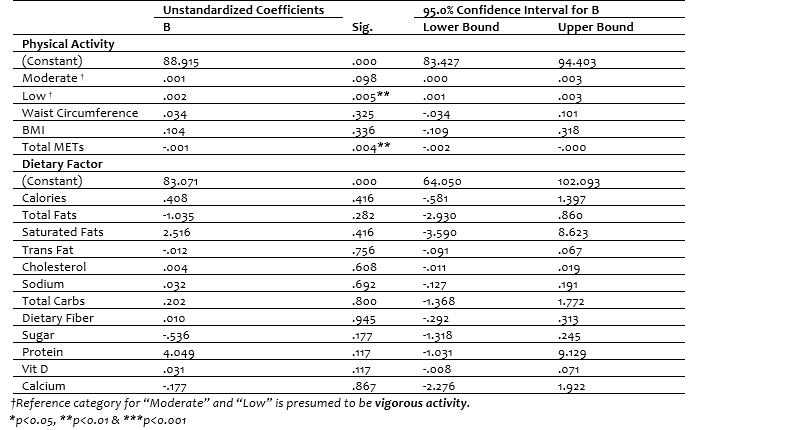
The multiple linear regression analysis explored the association between physical activity levels, dietary factors, and BSR (presumably Blood Sugar Regulation or a related biomarker). The results revealed that physical activity variables showed a stronger and statistically significant association with BSR compared to dietary variables. Specifically, individuals with low levels of physical activity had a significantly higher BSR compared to those with vigorous activity (B=0.002, p=0.005). This suggests that reduced physical activity is positively associated with poorer blood sugar regulation. Additionally, total daily MET-minutes were inversely associated with BSR (B=–0.001, p=0.004), indicating that increased overall physical activity is linked to better BSR. Although moderate activity showed a positive trend (B=0.001), it did not reach statistical significance (p=0.098). Other variables, such as waist circumference and BMI, showed no significant association with BSR, suggesting that body composition alone did not independently influence BSR once activity levels were accounted for. Regarding dietary factors, none of the variables, including calorie intake, macronutrients (fats, carbohydrates, protein), micronutrients (vitamin D, calcium), and dietary components like sugar and fibers, were significantly associated with BSR. While protein intake and vitamin D approached significance (p=0.117), their effects were not strong enough to draw firm conclusions in this model. (Table 1)
Table 1: Association Between Physical Activity and Dietary Factors with BSR
DISCUSSION
To determine the association between glucose concentration and physical activity and dietary factors among young adults, our analysis showed that lower physical activity levels were independently associated with higher glucose concentrations, whereas the broad panel of dietary variables was not a salient predictor of fasting/random glucose in this sample of young adults. Together, physical activity measures explained 8 % of the variance in glucose, with the “low activity” category and total daily MET minutes emerging as the strongest coefficients. In contrast, the fully adjusted diet model accounted for only 7 % of the variance, and no single nutrient met the conventional α ≤ 0.05 threshold.
Our finding that sedentary or low-active participants exhibited significantly higher glucose values aligns with a growing body of prospective and experimental evidence. Tracking children into early adulthood, Agbaje et al. showed that every additional hour per day spent in MVPA reduced fasting glucose by 0.05 mmol/L and HOMA‑IR by 3% after 13 years of follow-up [14]. Mainous III et al. reported that adults with ≤3 days/week of moderate exercise were 1.9 times more likely to have pre‑diabetic glucose levels than their active peers[15], and Sanca et al. found similar patterns using the IPAQ in sub-Saharan young adults[16]. An eight-week aerobic‑exercise program lowered fasting glucose by 6 % and improved insulin sensitivity in Qatari college women, whereas a four-week dose was insufficient[17]. Physical activity up‑regulates skeletal‑muscle GLUT‑4 translocation, enhances mitochondrial oxidative capacity, and improves hepatic insulin extraction, all of which converge to reduce circulating glucose [7].
Contrary to several epidemiological reports that link high intakes of refined carbohydrates, processed meat, and added sugars to dysglycaemia[10, 18], the current study did not identify calories, macronutrient partitioning, or specific micronutrients as independent correlates. Notably, weak associations have also been documented elsewhere. A cohort found no link between glycaemic load and fasting glucose after multivariable adjustment [19], and an Iranian study reported that overall diet‑quality indices were unrelated to fasting glucose in adult women[20]. These studies reinforce the possibility that diet glucose relationships are more readily detected in older or metabolically compromised samples than in ostensibly healthy young adults.
The lack of a significant relationship might be due to the small sample size or the use of a single 7-day food recall, which was averaged for analysis. It's also possible that participants underreported certain foods, especially unhealthy or “junk” foods, or misjudged portion sizes. This could have weakened the observed link between diet and blood glucose levels. In addition, young adults typically have better insulin function compared to older adults, so short-term unhealthy eating may not yet show up as high fasting blood sugar. Finally, because this study used a cross-sectional design and measured glucose at only one time point, it couldn’t capture the long-term effects of regular eating habits on blood sugar levels.
CONCLUSION
The findings of the study highlight the important role of physical activity in managing blood sugar levels during early adulthood, which is consistent with global research from both observational and experimental studies. The weak link between diet and glucose in our study may be due to limitations in how dietary data was collected, rather than a true lack of effect. Future studies that follow participants over time and use more accurate, objective measures of diet and lifestyle are needed to better understand how physical activity and nutrition together influence early metabolic health.
DECLARATIONS & STATEMENTS
Author’s Contribution
IUD, and LF: substantial contributions to the conception and design of the study.
IUD and MA: acquisition of data for the study.
MA and LF: interpretation of data for the study.
IUD: analysis of the data for the study.
IUD, MA, and LF: drafted the work.
IUD, MA, and LF: revised it critically for important intellectual content.
IUD, MA, and LF: final approval of the version to be published and agreement to be accountable for all aspects of the work in ensuring that questions related to the accuracy or integrity of any part of the work are appropriately investigated and resolved. All authors contributed to the article and approved the submitted version.
Ethical Statement
This study was approved by the Research and Ethical Committee (Riphah/RCRAHS-ISB/REC/MS-PT/01739). Written informed consent was obtained from participants in the study.
AI Use Statement
The authors used Grammarly to improve language clarity during manuscript preparation. All final content was reviewed and approved by the all authors.
Consent Statement
Informed consent was obtained from all subjects involved in the study.
Data Availability Statement
The data presented in this study are available on request from the corresponding author.
Acknowledgments
None to declare.
Funding Sources
None to declare.
Conflicts of Interest
REFERENCE
- Hossain MJ, Al-Mamun M, Islam MR. Diabetes mellitus, the fastest growing global public health concern: Early detection should be focused. Health Sci Rep. 2024;7(3):e2004. [CrossRef]
- Mathe A, van Gent MM, van Niekerk RL. Risk factor clusters for non-communicable diseases in adolescents in Eastern Cape, South Africa. Health SA. 2025;30:2855. [CrossRef]
- Goel A, Reddy S, Goel P. Causes, consequences, and preventive strategies for childhood obesity: a narrative review. Cureus. 2024;16(7):e64985. [CrossRef] [PubMed]
- Sharif H, Sheikh SS, Seemi T, Naeem H, Khan U, Jan SS. Metabolic syndrome and obesity among marginalised school-going adolescents in Karachi, Pakistan: a cross-sectional study. Lancet Reg Health Southeast Asia. 2024;21:100354. [CrossRef]
- E Y, Yang J, Shen Y, Quan X. Physical activity, screen time, and academic burden: a cross-sectional analysis of health among chinese adolescents. Int J Environ Res Public Health. 2023;20(6). [CrossRef]
- Popkin BM, Ng SW. The nutrition transition to a stage of high obesity and noncommunicable disease prevalence dominated by ultra-processed foods is not inevitable. Obes Rev. 2022;23(1):e13366. [CrossRef] [PubMed]
- Małkowska P. Positive effects of physical activity on insulin signaling. Curr Issues Mol Biol. 2024;46(6):5467-87. [CrossRef] [PubMed]
- Bird SR, Hawley JA. Update on the effects of physical activity on insulin sensitivity in humans. BMJ Open Sport Exerc Med. 2016;2(1):e000143. [CrossRef]
- Witek K, Wydra K, Filip M. A high-sugar diet consumption, metabolism and health impacts with a focus on the development of substance use disorder: A Narrative Review. Nutrients. 2022;14(14). [CrossRef]
- Pramono A, Fitranti DY, Nugroho KH, Sobirin MA, Syauqy A. The association between unhealthy food consumption and impaired glucose metabolism among adults with overweight or obesity: a cross-sectional analysis of the indonesian population. J Obes. 2023;2023:2885769. [CrossRef] [PubMed]
- Avram C, Nyulas V, Onisor D, Georgescu IM, Szakacs J, Ruta F. Food behavior and lifestyle among students: the influence of the university environment. Nutrients. 2024;17(1). [CrossRef] [PubMed]
- Craig CL, Marshall AL, Sjöström M, Bauman AE, Booth ML, Ainsworth BE, et al. International physical activity questionnaire: 12-country reliability and validity. Med Sci Sports Exerc. 2003;35(8):1381-95. [CrossRef] [PubMed]
- Fukagawa NK, McKillop K, Pehrsson PR, Moshfegh A, Harnly J, Finley J. USDA’s FoodData Central: what is it and why is it needed today? The American Journal of Clinical Nutrition. 2022;115(3):619-24. [CrossRef] [PubMed]
- Agbaje AO. The Interactive effects of sedentary time, physical activity, and fat mass on insulin resistance in the young population. J Clin Endocrinol Metab. 2024;110(1):e117-e31. [CrossRef] [PubMed]
- Mainous AG, 3rd, Tanner RJ, Anton SD, Jo A, Luetke MC. Physical activity and abnormal blood glucose among healthy weight adults. Am J Prev Med. 2017;53(1):42-7. [CrossRef] [PubMed]
- Sanca L, Có C, Namara N, Lopes A, Emanuel A, Oliveiros B, et al. Effect of self-reported physical activity on glycaemia and blood pressure in healthy participants from bissau: a cross-sectional study. Sports Med Open. 2025;11(1):19. [CrossRef] [PubMed]
- Sellami M, Almuraikhy S, Naja K, Anwardeen N, Al-Amri HS, Prince MS, et al. Eight weeks of aerobic exercise, but not four, improves insulin sensitivity and cardiovascular performance in young women. Sci Rep . 2025;15(1):1991. [CrossRef] [PubMed]
- Cha E, Paul S, Braxter BJ, Umpierrez G, Faulkner MS. Dietary behaviors and glucose metabolism in young adults at risk for type 2 diabetes. Diabetes Educ. 2018;44(2):158-67. [CrossRef] [PubMed]
- Fernandes AC, Marinho AR, Lopes C, Ramos E. Dietary glycemic load and its association with glucose metabolism and lipid profile in young adults. Nutr Metab Cardiovasc Dis. 2022;32(1):125-33. [CrossRef] [PubMed]
- Alami F, Mohseni GK, Ahmadzadeh M, Vahid F, Gholamalizadeh M, Masoumvand M, et al. The association between fasting blood sugar and index of nutritional quality in adult women. Front Nutr. 2022;9:883672. [CrossRef]

Submitted
Accepted
Published
How to Cite
Issue
Section
License
Copyright (c) 2025 Ihtisham Ullah Durrani, Laraib Fatima, Mafia Arshad

This work is licensed under a Creative Commons Attribution 4.0 International License.
Authors retain copyright and grant the journal right of first publication and allows others to share the work with an acknowledgment of the work’s authorship and initial publication in this journal. No use, distribution or reproduction is permitted which does not comply with these terms.