Effects of Calisthenic exercises on physical fitness among school going children: a randomized control trial
DOI:
https://doi.org/10.52567/trehabj.v9i02.102Abstract
Background: With the rising trend of sedentary behaviour and decreased physical activity among school-aged children, there is a growing concern regarding their physical health and fitness. Calisthenic exercises, bodyweight-based movements, offer a cost-effective and accessible method to improve multiple components of physical fitness without the need for equipment.
Objective: To evaluate the effects of structured Calisthenic exercise program on physical fitness among school-going children.
Material and Methods: This two-arm, parallel-group randomized controlled trial was conducted over 10 months at a private school in Sargodha, Pakistan. Forty-eight male children were randomly allocated into two groups: Group A (intervention group) performed structured Calisthenic exercises thrice weekly for 8 weeks, while Group B (control group) continued routine school activities. Physical fitness was assessed using the Eurofit Physical Fitness Test Battery at baseline, week 4, and week 8. Repeated measures ANOVA and independent t-tests were used for statistical analysis.
Results: Significant within- and between-group improvements were observed in the intervention group across multiple fitness parameters including balance (Flamingo Balance Test, p<0.001), coordination (Plate Tapping Test, p<0.001), leg power (Standing Broad Jump, p<0.001), flexibility (Sit-and-Reach Test, p=0.03), muscular endurance (Sit-ups in 30 seconds and Bent Arm Hang, p<0.001), and aerobic capacity (20m Shuttle Run, p=0.042). Hand grip strength showed significant improvement in the intervention group over time (p=0.002), though not in comparison between groups. The control group showed minimal or no significant improvements.
Conclusion: Structured Calisthenic exercises significantly enhance physical fitness components including balance, flexibility, coordination, endurance, and strength in school-aged boys. Incorporating such programs into school routines offers a practical and scalable strategy to combat physical inactivity in children.
INTRODUCTION
Physical fitness plays a crucial role in the overall health and development of children. With increasing sedentary lifestyles and screen time, many children are experiencing declining physical fitness levels, which can negatively affect their physical, mental, and social well-being[1, 2]. Calisthenic exercises, which are body-weight movements such as push-ups, pull-ups, squats, and jumping jacks, offer a practical and accessible method to improve physical fitness without requiring specialized equipment[3]. These exercises enhance muscular strength, endurance, flexibility, coordination, and cardiovascular health[4]. Introducing Calisthenic routines in schools can promote healthy habits and improve the physical fitness of children, thereby contributing to their holistic development[5].
A study by Katsanis et al. (2021) demonstrated significant improvements in muscular strength and cardiovascular endurance after an 8-week Calisthenic training program in adolescents[6]. Similarly, regular Calisthenic activities improved flexibility and balance, which are critical for overall motor development[7]. Researches also highlight the role of physical fitness in enhancing academic performance, mental health, and social skills[8, 9].
However, there is limited research specifically targeting the Calisthenic exercises that can be effectively integrated into daily school routines to yield long-term benefits. The rationale behind studying the effects of Calisthenic exercises among school children stems from the need to identify cost-effective, easily implementable interventions that improve physical fitness and promote healthy lifestyles. Ideal settings for such interventions are the schools, due to their structured environment and access to large populations of children. Future health risks such as obesity, cardiovascular diseases, and mental health disorders can be prevented by physical fitness in children. This study's objective was to understand how Calisthenic exercises can be adapted and incorporated into school programs to enhance physical fitness and well-being.
MATERIALS AND METHODS
Study Design & Setting: This study was a two-arm, parallel-group randomized controlled trial, completed In ten months, from June 2020 to April 2021. The study was initiated after ethical approval from the research and ethical committee (RIU/FRAHS-ISB/REC/0766), Riphah International University Islamabad. The trial was conducted at the Sanai School System, Sargodha a private educational institution after approval from the Principal. Located in Sargodha, Pakistan. The study adhered to the ethical principles outlined in the Declaration of Helsinki.
Participants: The participants included in the study were male school-going children aged between 8-13 years, having a normal BMI as aged based BMI on WHO guidelines. Moreover, children were able to perform at least 10 repetitions of selected calisthenic exercises. While children having known physical or cognitive impairment or disability, or experiencing acute illness were excluded from the study. The recruitment of the participants was done using a non-probability purposive sampling method. After screening based on the selection criteria, written informed consent was obtained from the parents/guardians, and verbal assent was taken from the children. Participants were then randomly allocated to one of two groups.
Sample Size Calculation: The required sample size was calculated using G*Power software (ver. 3.1.9.7) based on medium effect size (f)=0.25, alpha (α)=0.05, power (1−β)=0.80 for two groups and with three measurement levels. The calculated sample size was n=48 participants, with n=24 participants per group.
Randomization and Allocation: N=48 participants were randomly assigned to Group A (Calisthenic) or Group B (Control group) using simple randomization generated through a random number generator for a customized random number table. Allocation concealment was ensured using sealed opaque envelopes. Due to the nature of the physical interventions, participants and trainers could not be blinded; however, outcome assessors were blinded to group allocation to minimize bias.
Intervention: Group A (Calisthenic Exercises) Participants in Group A underwent a structured calisthenic exercise program conducted three times a week for 8 weeks, under the supervision of Physical Therapist. Each session lasted approximately for 30 minutes and included a 3-minute warm-up followed by a progression of exercises mentioned in table 1.
Table 1: Calisthenic Exercises

Group B (Routine Physical Activity): Participants in Group B continued their regular physical activities at school during recess. No additional structured exercises were introduced. All assessments were performed at the same intervals as the experimental group.
Outcome Measures: The Eurofit Physical Fitness Test Battery was used to evaluate physical fitness at baseline, week 4, and week 8. This battery includes Flamingo Balance Test (FBT), Plate Tapping (PT), Sit-and-Reach Test, Standing Broad Jump (SBJ), Hand Grip Strength Test (HG), Sit-Ups in 30 Seconds, Bent Arm Hang (BAH), 20m Endurance Shuttle Run (Bleep Test). All tests were administered by trained assessors (physical trainers) who were blinded to group allocation[10].
Data Analysis: Data were analyzed using SPSS version 20 with the level of significance set at p<0.05. The continuous variables were reported as mean ± standard deviation (SD), while categorical data were presented as frequencies and percentages. A Repeated Measures ANOVA was used to examine within-group changes over time (baseline, week 4, week 8). An independent samples t-test was used to compare between-group differences at each time point. Further, the post-hoc analyses with Bonferroni correction were used for pairwise comparisons when applicable.
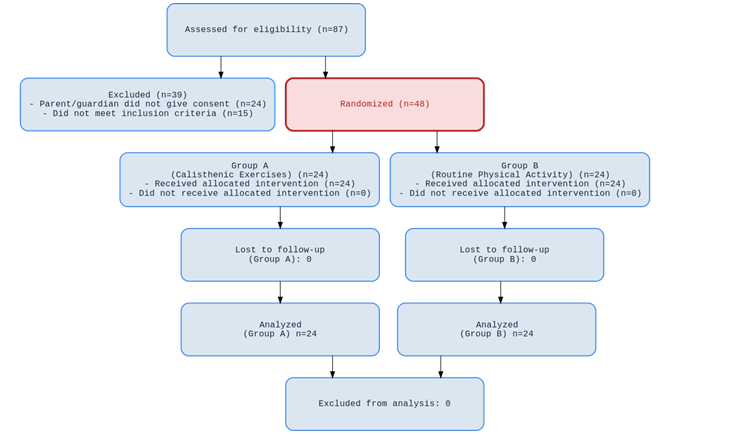
Figure 1: Study CONSORT diagram
RESULTS
The mean age of the study participants was 10.88±1.71 years and BMI was 20.15±2.06. The BMI category showed that n=15 participants were healthy, n=7 were at risk of overweight and the remaining n=3 participants were overweight.
With-in group analysis showed that the control group had no significant improvement (p≥0.05) in all variables except the flamingo balance test, (p=0.012) which showed significant improvement with a large effect size in balancing after 8 weeks of treatment. The experimental group showed significant improvement in balance measured by the flamingo balance test (p<0.05), with a large effect size throughout the treatment. The upper body reaction time, hand-eye quickness, and coordination significantly improved after 8 weeks of treatment by plate tapping (p<0.05). As well as standing broad jump test p<0.05 showed significant improvement in leg power with a large effect size after the treatment duration. The sit-up 30 sec test showed significant improvement (p<0.05) with a large effect size throughout the treatment in the leg strength and stamina of participants. The bent arm hang test (p<0.05) showed significant improvement with a large effect size in muscular endurance of the arm and shoulder after treatment duration. While the stand reach test p< 0.05 showed significant improvement with a large effect size in flexibility of standing and aerobic fitness 20m Bleep Test VO2 Max test (p<0.05) also showed significant improvement with a large effect size after 4 weeks of treatment. The hand grip test showed no significant improvement (p≥0.05) throughout the treatment. (table 2)
Table 2: Within group changes
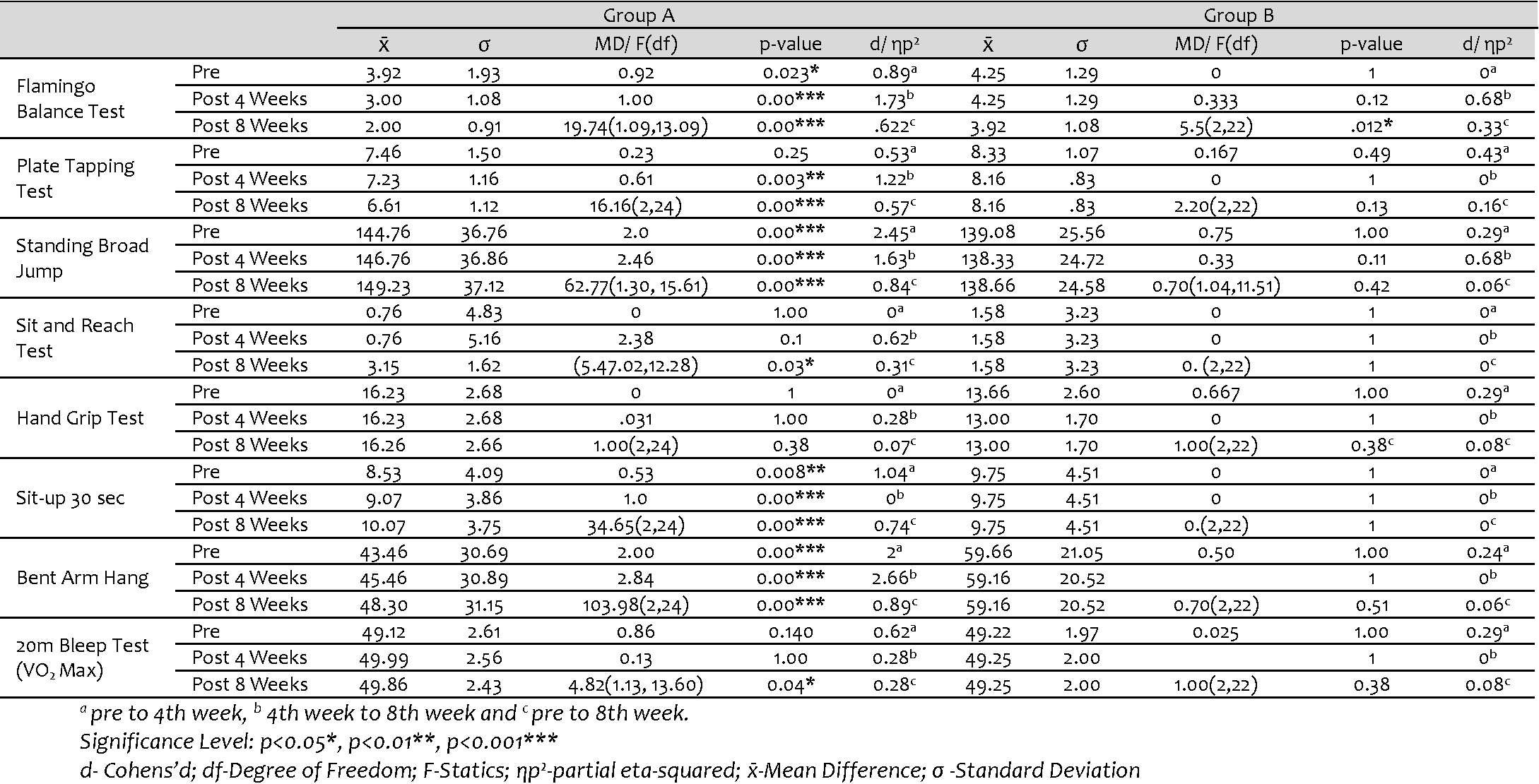
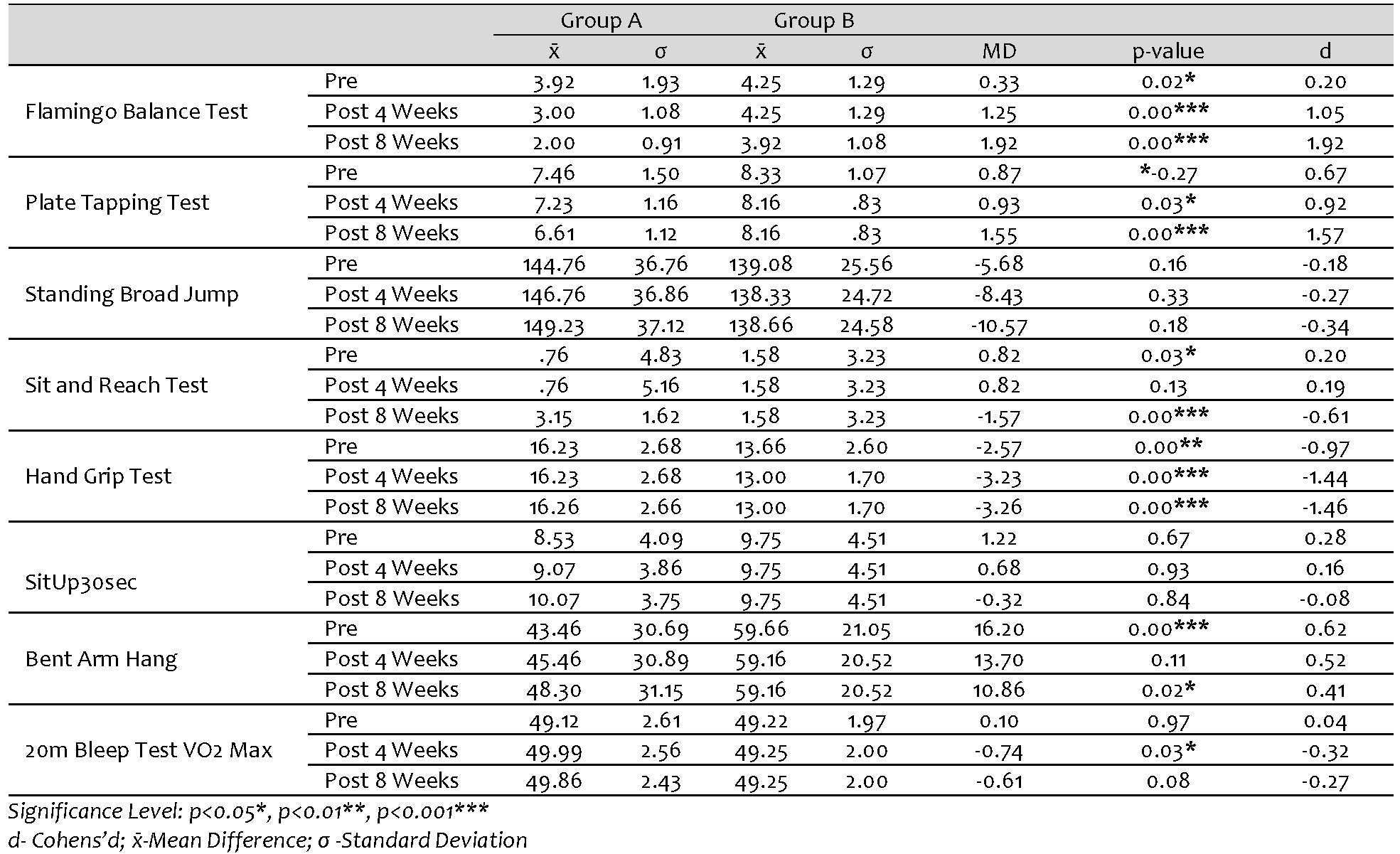
Table 3: Comparison between the groups
A statistically significant difference was found in the mean change of the Hand Grip Test, with the experimental group (16.24±2.68) showing greater hand grip strength compared to the control group (13.22±1.74), p=0.002, with a large effect size (Cohen’s d=-1.39). This indicates a substantial improvement in grip strength in the experimental group. While no significant (p≥0.05) difference regarding Sit and Reach Test, and Bent Arm Hang Test. (Figure 2)
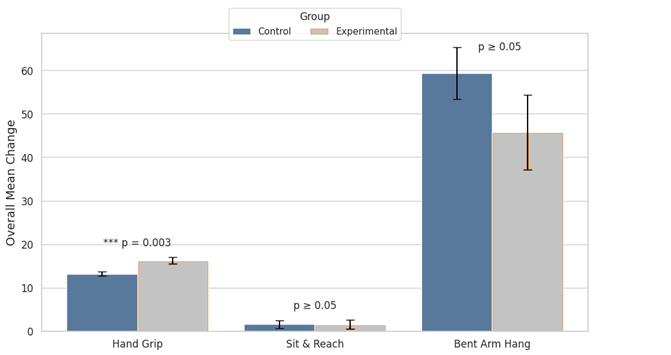
Figure 2: Comparison of Mean Change of groups from baseline to 12th week
DISCUSSION
This study determined the effects of an 8-week structured Calisthenic exercise program on various physical fitness parameters in school-going boys. The findings demonstrate that Calisthenic training produced significant improvements in multiple fitness parameters compared to routine activity at school, particularly in balance, coordination, flexibility, muscular endurance, and aerobic capacity. These results are consistent with and add to the growing body of literature supporting the role of body-weight exercises in paediatric fitness promotion.
The improvement observed in balance, as measured by the Flamingo Balance Test, is supported by previous findings, that enhanced postural control in children may be improved by calisthenic training[11]. This may be attributed to the neuromuscular adaptations[12] resulting from dynamic and static body control during exercises like bear crawls and crab walks, which challenge the vestibular and proprioceptive systems.
Significant enhancement in hand-eye coordination and upper limb reaction time, reflected in Plate Tapping Test results, aligns with Kojic (2024), who highlighted improvements in motor coordination through regular structured physical activity[13]. Mechanistically, these changes may be driven by increased cortical stimulation and synaptic plasticity[14] from repeated, rhythm-based movements integral to calisthenics.
The Standing Broad Jump and Sit-Ups in 30 Seconds test results indicate improved lower limb explosive strength and core muscular endurance respectively. These findings are in agreement with Sort well et al. (2021), who demonstrated that plyometric and bodyweight circuits enhance muscle fibre recruitment and anaerobic endurance in children[15]. Exercises such as bunny jumps and crouching tigers likely activated fast-twitch muscle fibres and increased neuromuscular efficiency[16].
Improvement in the 20-meter Shuttle Run (VO₂ max) confirms the aerobic benefits of calisthenic exercise. Consistent with Jovanović et al. (2024), who reported improved cardiovascular endurance in children undergoing high-repetition bodyweight exercise regimes[17], our results suggest that calisthenics, although non-equipment based, sufficiently stimulate the cardiorespiratory system due to their circuit style implementation and minimal rest periods[18].
Flexibility, as assessed by the Sit-and-Reach Test, also improved significantly. This is observed to improve hamstring and lower back flexibility in children undergoing a general dynamic warm-up followed by full-body movement exercises[19, 20]. In calisthenics, movements involving multiple joints like bird-dog and crouching tiger contribute to an increased range of motion and reduced muscle tightness.
The Hand Grip Strength showed a statistically significant mean improvement in the experimental group over time. This may be explained by the nature of calisthenic movements, which emphasize functional and dynamic muscular endurance over isolated static strength. Repetitive body weight increases oxidative capacity in the forearm muscles, improving their endurance and resistance to fatigue[21]. Exercises involving sustained positions, including crab walks and crouching tigers, promote isometric strength gains through prolonged time under tension of the forearm and intrinsic hand muscles[22]. Additionally, these dynamic and stabilizing movements enhance motor unit recruitment, synchronization, and coordination, all of which contribute to improvements in functional grip strength[23, 24]. The lack of substantial improvements in the control group across most parameters underscores the limited effectiveness of unstructured or recess-based physical activity. An study by Tanveer et al supports the findings that school-based interventions must be intentional, guided, and consistent to elicit measurable benefits[25].
The nutritional factors were not controlled or recorded, which may potentially influence the fitness outcomes. Moreover, the study was conducted in one private school, so the findings may not reflect the diversity of socioeconomic or geographic school settings. Though improved fitness is often associated with better cognition and mood, these variables were also not assessed.
CONCLUSION
The findings reinforce that structured Calisthenic exercise programs can significantly improve balance, coordination, endurance, strength, and flexibility among school-aged boys. These results support the integration of bodyweight-based fitness modules in school curricula as a cost-effective, accessible, and impactful approach to combat sedentary lifestyles in children. Future studies should include diverse populations, compare different types of physical activity, and explore the cognitive and psychosocial effects of such interventions while controlling the confounder which may affect the effects. Although physical education departments are in the majority of schools, there is a decreased trend of structured activity in schools. This study may guide to incorporate the structured exercise program as a routine activity to enhance physical fitness and may avoid future risks of diseases.
DECLARATIONS & STATEMENTS
Author’s Contribution
FZ: substantial contributions to the conception and design of the study.
FZ, MK, and LZ: acquisition of data for the study.
FZ, BF and LZ: interpretation of data for the study.
FZ: analysis of the data for the study.
FZ: drafted the work.
FZ, MK, BF, and LZ: revised it critically for important intellectual content.
FZ, MK, BF, and LZ: final approval of the version to be published and agreement to be accountable for all aspects of the work in ensuring that questions related to the accuracy or integrity of any part of the work are appropriately investigated and resolved. All authors contributed to the article and approved the submitted version.
Ethical Statement
The study was initiated after ethical approval from the research and ethical committee (RIU/FRAHS-ISB/REC/0766), Riphah International University Islamabad. The trial was conducted at the Sanai School System, Sargodha institution after approval from the Principal. Located in Sargodha, Pakistan
AI Use Statement
No AI was used for content generation, data analysis, or interpretation.
Consent Statement
Informed consent was obtained from all subjects involved in the study.
Data Availability Statement
The data presented in this study are available on request from the corresponding author.
Acknowledgments
None to declare.
Funding Sources
None to declare.
Conflicts of Interest
None to declare.
REFERENCES
- Jaekel J. The role of physical activity and fitness for children’s wellbeing and academic achievement. Pediatr Res. 2024;96(7):1550-1. [CrossRef] [PubMed]
- Walker R, House D, Salway R, Emm-Collison L, Hollander LE, Sansum K, et al. The new normal for children’s physical activity and screen viewing: a multi-perspective qualitative analysis of behaviours a year after the COVID-19 lockdowns in the UK. BMC Public Health. 2023;23(1):1432. [CrossRef] [PubMed]
- Israel RC, Bailey JE, Cerna AGS, Repizo DI, Arguilles AT, Gula LP. Athletic calisthenics: strengthening the athletic ability of football male student-athlete through push-ups and squats. J. Teach. Educ. Educ. 2024;19(02):19-23. [CrossRef]
- Prasad A, Saini A. Impact of specific calisthenics conditioning program on physiological and health-related fitness parameters of sedentary adults. Indian J Physiol Allied Sci. 2024;76(02):39-43. [CrossRef]
- Chen Q, Witayapayungkul Y, Tasnaina N. Developing the calisthenics exercise program to improve physical fitness of the primary school students. Int. J. Sociol. Anthropol. 2025;5(2):215-24. [CrossRef]
- Katsanis G, Chatzopoulos D, Barkoukis V, Lola AC, Chatzelli C, Paraschos I. Effect of a school-based resistance training program using a suspension training system on strength parameters in adolescents. J. Phys. Educ. Sport. 2021;21(5):2607-21. [CrossRef]
- Pfeifer CE, Ross LM, Weber SR, Sui X, Blair SN. Are flexibility and muscle-strengthening activities associated with functional limitation? Sports Med Health Sci. 2022;4(2):95-100. [CrossRef] [PubMed]
- Chaddock L, Erickson KI, Prakash RS, Kim JS, Voss MW, Vanpatter M, et al. A neuroimaging investigation of the association between aerobic fitness, hippocampal volume, and memory performance in preadolescent children. Brain Res. 2010;1358:172-83. [CrossRef] [PubMed]
- Al Doghan MA, Sadiq M. The impact of physical activities and psychological health on students academic performance: mediating role of students mental health. International Journal of Instructional Cases. 2024;8(2):211-34. [CrossRef]
- Yadav SB, Sathe PK, Karotiya P, Sathe A, Kumar DV. Evaluation of physical fitness in Indian children by EUROFIT test battery. Saudi J. Sports Med. 2024;24(1):13-8. [CrossRef]
- Panihar U, Rani D. The effect of calisthenics training on physical fitness parameters and sports specific skills of soccer players: A randomized controlled trial. Advances in Rehabilitation. 2022;36(2):23-31. [CrossRef]
- Genc H. Effect Of The calisthenics exercises on static and dynamic balance in tennis players. Int J Appl Exerc Phil. 2020;09(03):12. [CrossRef]
- Kojić F, Arsenijević R, Grujić G, Toskić L, Šimenko J. Effects of structured physical activity on motor fitness in preschool children. Children (Basel). 2024;11(4). [CrossRef] [PubMed]
- Cirillo J, Ward CR, Gant N, Reading SA, Ren A, Byblow WD. Modulation of primary motor cortex after experimentally induced and use-dependent plasticity in young and older adults. Exp Brain Res. 2025;243(7):159. [CrossRef] [PubMed]
- Sortwell A, Newton M, Marinho DA, Ferraz R, Perlman D. The effects of an eight week plyometric-based program on motor performance skills and muscular power in 7–8-year-old primary school students. Int. J. Kinesiol. Sports Sci. 2021;9(4):1-12. [CrossRef] [PubMed]
- Kaya Utlu D. Description, types, and prescription of the exercise. in: kaya utlu d, editor. functional exercise anatomy and physiology for physiotherapists. cham: Springer International Publishing; 2023. p. 3-18. [CrossRef]
- Jovanović R, Živković M, Stanković M, Zoretić D, Trajković N. Effects of school-based high-intensity interval training on health-related fitness in adolescents. Front Physiol. 2024;15:1487572. [CrossRef] [PubMed]
- Kotarsky CJ, Christensen BK, Miller JS, Hackney KJ. Effect of progressive calisthenic push-up training on muscle strength and thickness. J Strength Cond Res. 2018;32(3):651-9. [CrossRef] [PubMed]
- Ohtaka M, Saito M, Ito Y. Stretching exercises for growing children: evaluation of obesity, flexibility, pain and injury of musculoskeletal organs before and one year later. J Rural Med. 2024;19(3):150-7. [CrossRef] [PubMed]
- Mayorga-Vega D, Merino-Marban R, Manzano-Lagunas J, Blanco H, Viciana J. Effects of a stretching development and maintenance program on hamstring extensibility in schoolchildren: a cluster-randomized controlled trial. J Sports Sci Med. 2016;15(1):65-74. [PubMed]
- Scribbans TD, Vecsey S, Hankinson PB, Foster WS, Gurd BJ. The effect of training intensity on vo(2)max in young healthy adults: a meta-regression and meta-analysis. Int J Exerc Sci. 2016;9(2):230-47. [CrossRef] [PubMed]
- Oranchuk DJ, Storey AG, Nelson AR, Cronin JB. Isometric training and long-term adaptations: effects of muscle length, intensity, and intent: a systematic review. Scand J Med Sci Sports. 2019;29(4):484-503. [CrossRef] [PubMed]
- Ciucurel C, Iconaru EI. Nonlinear dynamics analysis of handgrip strength using the poincaré plot method through video processing techniques. J Funct Morphol Kinesiol. 2024;9(4). [CrossRef] [PubMed]
- Garcia-Retortillo S, Romero-Gómez C, Ivanov PC. Network of muscle fibers activation facilitates inter-muscular coordination, adapts to fatigue and reflects muscle function. Commun Biol. 2023;6(1):891. [CrossRef] [PubMed]
- Tanveer M, Asghar E, Badicu G, Batrakoulis A, Tanveer U, Brand S, et al. Effectiveness of a school-based physical activity intervention on overweight and obesity among children and adolescents in Pakistan. PLoS One. 2025;20(2):e0317534. [CrossRef]

Submitted
Accepted
Published
How to Cite
Issue
Section
License
Copyright (c) 2025 Faseeh Zulqernain, Mehandar kumar, Breera Farooq, Laiba Zia

This work is licensed under a Creative Commons Attribution 4.0 International License.
Authors retain copyright and grant the journal right of first publication and allows others to share the work with an acknowledgment of the work’s authorship and initial publication in this journal. No use, distribution or reproduction is permitted which does not comply with these terms.