Effects of moderate intensity intermittent training versus continuous training on indices of cardio-metabolic health in women with hyperlipidemia
DOI:
https://doi.org/10.52567/trehabj.v7i04.40Keywords:
Continuous Training, Moderate Intensity Intermittent Training, HyperlipidemiaAbstract
Background: Moderate intensity intermittent and continuous training are in practice for muscle strengthening and physical activity. These trainings can be used for cardiometabolic health of hyperlipidemic patients.
Objective: to determine the effects of moderate-intensity intermittent versus continuous training on indices of cardio-metabolic health in women with hyperlipidemia.
Methods: A randomized clinical trial was conducted at Milestone Fitness Gym in Sialkot from August to December 2021. Women between 30 to 40 years old with hyperlipidemia were included by using a non-probability convenience sampling technique. A total of Twenty (n=20) participants were randomly divided into two groups by lottery method. Moderate-intensity intermittent training was given to Group A (n=10), and moderate-intensity continuous training was given to Group B (n=10) by the gym trainer 3 days per week for 5 weeks. The lipid profile for hyperlipidemia, step test, modified Borg Scale, and timed up-and-go test were used for cardiometabolic health and assessed at the baseline and after 5 weeks of training.
Results: The mean age was 34±3.43 years. There was no significant difference (p≥0.05) in lipid profile, lipid profile, Borg scale, and time up and go test when between both groups analysis was done. While within-group analysis shows that there was a significant difference (p<0.05) in all outcome measures of both groups.
Conclusion: It is concluded that both techniques, moderate-intensity intermittent versus continuous training were effective equally on indices of cardio-metabolic health in women with hyperlipidemia.
INTRODUCTION
Hyperlipidemia is a term used to describe high blood fat levels, such as cholesterol and triglycerides. Hyperlipidemia is most commonly associated with rich fat diets, sedentary lifestyles, obesity, diabetes, and genetic causes. Middle-aged females are more prone to hyperlipidemia due to fertility reasons, at this age, most of the women are getting hysterectomy, oophorectomy, or hormonal imbalances[1]. The prevalence of hyperlipidemia in Pakistan was 37.1%[2]. The general frequency of hyperlipidemia was 33.8%, with the associated risk of triglyceride (TG) was 12.8%; hypercholesterolemia was 16.1%, high-density lipoprotein cholesterol (cHDL) was 15.0% and low-density lipoprotein cholesterol (cLDL) was 42.2% [3].
The cardiovascular risk factors were observed and results show an overall predominance of hypercholesterolemia of 12% and a frequency of dyslipidemia that reaches somewhere in the range of 32.8% [4]. Hyperlipidemia is a significant general medical issue with expanded occurrence and predominance worldwide. Hyperlipidemia-specific biomarkers would work on clinical findings and helpful treatment at early disease stages [5]. The previous investigation looked at the impacts of intermittent training on heart rate variability (HRV) in 2020 [6].
In women with coronary disease, treating hypercholesterolemia can lower mortality from coronary heart disease [7]. Exercise is essential for treating these issues and assisting with metabolic abnormalities [8]. Consistent workouts of moderate intensity (CMI) demonstrate consistency in effectiveness. Running at a high intensity for short intervals increases exercise adherence since it is affordable and has positive health effects [9, 10]. Exercises that are both aerobic and anaerobic, particularly those that are intermittent and continuous and have a range of intensities, remove body fat. With little research contrasting the effects of continuous versus intermittent exercise, both exercise modes have benefits based on age and intent [11, 12].
Although the combination of moderate-intensity intermittent training versus continuous training, including diet modification and patient education, may have been effective for hyperlipidemia, no reported studies have compared whether moderate-intensity intermittent intensity versus continuous training alone is more or less effective in treating hyperlipidemia without diet modification. Moreover, women might respond differently to various exercise protocols. Some might find it more sustainable and engaging to perform intermittent training, while others might prefer continuous training. Investigating which protocol leads to better results for hyperlipidemia patients is important. The study's objective was to determine the effects of moderate-intensity versus continuous exercises on indices of cardiometabolic health in females.
METHODOLOGY
This randomized clinical trial (NCT05078736) was conducted at Milestone Fitness Gym in Sialkot from August to December 2021. The research and ethical committee (REC) of Riphah International University Islamabad (Lahore Campus), Pakistan, approved the study protocol with the reference number REC/RCR & AHS/21/0409. All the participants provided written informed consent to participate in the study.
Women with hyperlipidemia ages ranging from 30 to 40 years were included because at this stage females are less fertile so the risk of hyperlipidemia is high, while women with any serious cardiac, musculoskeletal, or systemic conditions were excluded.
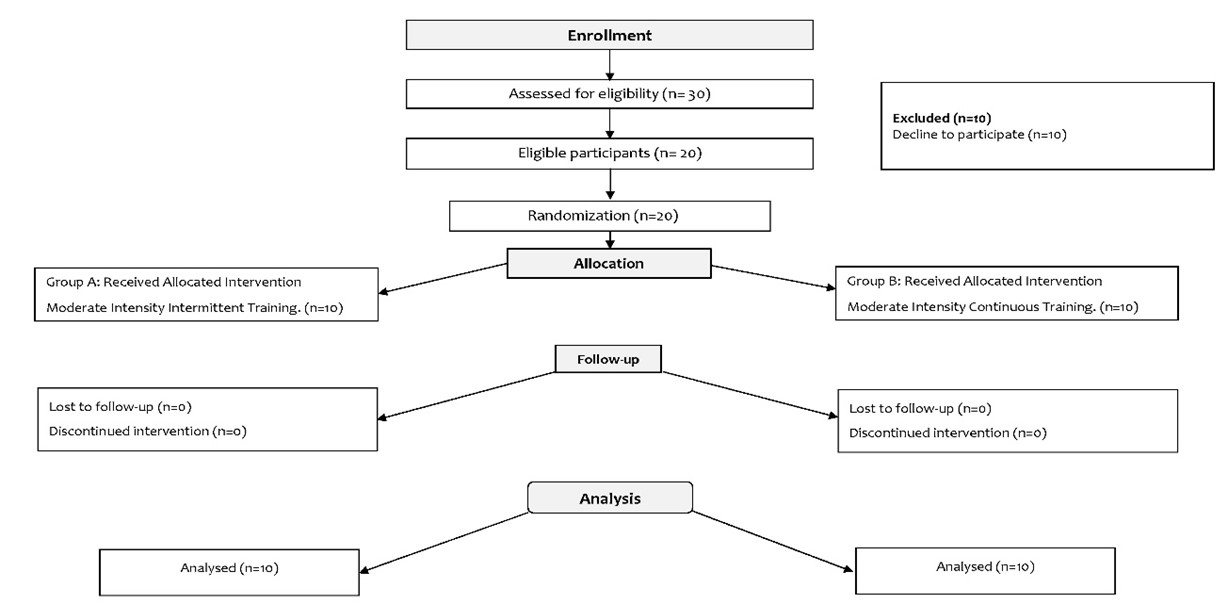
Figure 1: CONSORT diagram
The sample size was n=20 with a 10% attrition rate calculated from Epi tool software by adding the mean and standard deviation of previous literature by using the outcome measure Borg scale [13]. The screening was carried out of n=40 participants through a nonprobability sampling technique, n=30 fulfilled the inclusion criteria, and n=20 finally gave written consent for enrolment in the study. Outcome assessors were blinded in this study. Patients were blindly allocated into two groups Group A and B by lottery method. There was no dropped-out participant. All the study participants were divided into two groups by lottery method. The CONSORT diagram is shown in Figure 1.
Group A Performed Moderate-intensity intermittent training, running 5 km at 70% of the maximal aerobic speed (1 km running with 1-minute passive recovery) for 5 weeks including 3 days per week [14]. 10 10-minute warm-up and cool-down sessions were also included.
Group B Performed moderate-intensity continuous training, participants ran continuously the same 5 km at 70% of maximal aerobic speed, gym trainer performed exercises for 5 weeks including 3 days per week. 10 minute warm-up and cool-down session was also included in both groups [15].
To measure the hyperlipidemia, and lipid profile a blood test consisting of triglycerides, HDL, LDL, and cholesterol was done in Excel Lab Sialkot. The step test, Modified Borge scale (MBS), and Timed up and Go test (TUG) were used to measure cardiometabolic health after receiving the interventions. The Step up test presented good test-retest reliability (ICC = 0.87; 95% CI = 0.79-0.91), it was used to measure a person’s aerobic fitness [16]. The Modified Borg scale (MBS (Borg Rating of Perceived Exertion (RPE) scale), developed by Swedish researcher Gunnar Borg, has excellent interrater reliability (ICC = 0.94) and convergent validity, it used for measuring an individual’s effort and exertion, breathlessness and fatigue during physical work and so is highly relevant for occupational health and safety practice. In its simplest terms, it provides a measure of how hard it feels that the body is working based on the physical sensations that the subject experiences, including increased heart rate, increased respiration or breathing rate, increased sweating and muscle fatigue [17]. The Timed up and Go test (TUG) has good test–retest reliability (ICC 0.80–0.99), validity, and sensitivity to change, it was used to assess mobility, balance, walking ability, and fall risk [18].
The data of the Lipid profile, Modified Borg scale, step test and down test, and Timed Up and Go test were measured at baseline and after 5 weeks. Data analysis was performed using SPSS 25. Using the Shaphiro-Wilk test to determine the data's normality, it was determined that the data had a normal distribution (p≥0.05). The independent t-test and the paired-sample t-test were then used in a parametric analysis to compare variables between groups and within groups, respectively.
RESULTS
The mean age in both groups was 34.00 + 3.43 years, while the mean body mass index was 25.64 + 2.50 kg/m².
Across the groups, the comparison showed that there was no statistical difference between the treatment methods (p>0.05). However, in pairwise comparison, both groups were statistically significant, showing that both treatment plans were equally effective and showed clinical improvement shown in Tables 1 and 2.
Table 1: Across and Within Group Analysis of Borg Scale, TUG, HR and lipid profile

DISCUSSION
This study aimed to compare the effects of moderate-intensity intermittent and continuous training on indices of cardio-metabolic health in women with hyperlipidemia. There was no significant difference in both groups, but both groups were clinically effective.
From previous literature, it was proved that moderate-intensity training was more effective in reducing the cardio-metabolic indices and in this study, both treatments were equally effective either continuous or intermittent. Because aerobic exercises always have some physiological effect and improve lipid profile faster as compared to any other exercise. These exercises improve the health status and physical function in any case as these two trainings of moderate intensity (continuous and intermittent) show no difference in between-group comparisons because there was no difference in the intensity but show significant difference in within-group comparisons [19].
A study was conducted in 2019 on MIIT in players between the ages of 16 to 30 years and they concluded that moderate-intensity intermittent training is used to increase functional capacity and physical activity; they found significant improvement in Time Up and Go Test readings. In comparison to the recent study conducted on females with hyperlipidemia, MIIT and CT were used as treatment plans and results show significant improvement in the Time Up and Go Test so this study correlates with the current study [20]. Another study was conducted on continuous training in weight lifters and marathon runners with ages ranging from 15 to 35 years in 2020 and they concluded that continuous training has significant improvement in the time up and go test but in the current study Time up and go test and cardiometabolic indices were also monitored and both groups show significant results. Results show that exercises have positive effects on the cardiometabolic indices either continuous training or intermittent training was used [21]. The previous study was conducted in 2019 by Lange and Kucharski, on the effects of aerobic exercises in patients with hyperlipidemis from the age of 25 to 35 years and they concluded that aerobic exercises are used to treat hyperlipidemis as it sounds safe and easy to practice. In contrast to the recent study, this study has only aerobic exercises while the current study used continuous and moderate intensity intermittent training programs as a treatment plan for the patients with diagnosed hyperlipidemia at the gym and results prove that both techniques have the same effects on cardiometabolic indices and physical activity [22].
Another study was conducted by Zhang and Zou in 2021 on MIIT in overweight females aged 20 to 35 years, only MIIT was used as a choice of treatment. They concluded that moderate-intensity intermittent exercises are used for different purposes in gyms and one of the major ones is the fat reduction they introduced these trainings as fat reduction booster exercises. The results of this study were strongly correlated with the recent study, as a recent study was conducted on 30 to 40-year-old females with hyperlipidemia, MIIT and CT were used as treatment plans. Results prove that moderate-intensity Continuous and intermittent training show significant improvement in cholesterol which is the combination of all fat components of the body [23].
There are also some limitations in the study as there was no monitoring of the level of exertion and VO2 max. The sample size was not as sufficient as in previous studies. There was no control over the use of medications (by participants) during treatment sessions.
CONCLUSION
It was concluded that moderate-intensity intermittent and continuous training techniques were equally effective on indices of cardio-metabolic health in women with hyperlipidemia while there was no significant difference between the two groups.
DECLARATIONS & STATEMENTS
Author’s Contribution
The following format should be used for author’s contribution.
SZ: substantial contributions to the conception and design of the study.
SZ and SSUR: acquisition of data for the study.
SSUR and MI: interpretation of data for the study.
MI: analysis of the data for the study.
MI: drafted the work.
SZ, SSUR and MI: revised it critically for important intellectual content.
SZ, SSUR and MI: final approval of the version to be published and agreement to be accountable for all aspects.
of the work in ensuring that questions related to the accuracy or integrity of any part of the work are appropriately investigated and resolved. All authors contributed to the article and approved the submitted version.
Ethical Statement
The study was conducted at Milestone fitness gym in Sialkot from August to December 2021. The research and ethical committee (REC) of Riphah International University Islamabad (Lahore Campus), Pakistan, approved the study protocol with the reference number of REC/RCR & AHS/21/0409.
Consent Statement
Informed consent was obtained from all subjects involved in the study.
Data Availability Statement
The data presented in this study are available on request from the corresponding author.
Acknowledgments
None to declare.
Conflicts of Interest
None to declare.
Funding
None to declare.
REFERENCES
3. Ramírez AAÁ, Peláez JL, Bermúdez IM, Botero JYG. Prevalence of hyperlipidemia and its associated factors in university students in Colombia. Heliyon. 2020;6(11)1-7. [CrossRef][PubMed]
5. Argemí-Armengol I, Villalba D, Tor M, Bertolín JR, Latorre MA, Álvarez-Rodríguez J. Effects of dietary roughage on organic pig performance, behaviour and antioxidants accretion in perirenal adipose tissue. Livestock Science. 2020;241:104255. [CrossRef]
6. Adeloye D, Abaa DQ, Owolabi EO, Ale BM, Mpazanje RG, Dewan MT, et al. Prevalence of hypercholesterolemia in Nigeria: a systematic review and meta-analysis. Public Health. 2020;178:167-78. [CrossRef][PubMed]
7. Burma JS, Copeland PV, Macaulay A, Khatra O, Smirl JD. Effects of high-intensity intervals and moderate-intensity exercise on baroreceptor sensitivity and heart rate variability during recovery. Appl Physiol Nutr Metab. 2020; 45(10):1156-64. [CrossRef][PubMed]
8. He N, Ye H. Exercise and Hyperlipidemia. Adv Exp Med Biol. 2020; 1228:79-90. [CrossRef][PubMed]
9. Gambassi BB, Almeida FdJF, Almeida AEAF, Ribeiro DAF, Gomes RSA, Chaves LFC, et al. Acute Response to Aerobic Exercise on Autonomic Cardiac Control of Patients in Phase III of a Cardiovascular Rehabilitation Program Following Coronary Artery Bypass Grafting. Braz J Cardiovasc Surg. 2019; 34:305-10. [CrossRef][PubMed]
10. Lin Y, Gao W. The effects of physical exercise on anxiety symptoms of college students: A meta-analysis. Front Psychol. 2023; 14:1136900.1-9. [CrossRef][PubMed]
11. Oliveira J, Gentil P, Naves JP, Souza Filho LF, Silva L, Zamunér AR, et al. Effects of High Intensity Interval Training versus Sprint Interval Training on Cardiac Autonomic Modulation in Healthy Women. Int J Environ Res Public Health. 2022; 19(19):12863.1-11. [CrossRef][PubMed]
12. Tarantino D, Theysmans T, Mottola R, Verbrugghe J. High-Intensity Training for Knee Osteoarthritis: A Narrative Review. Sports (Basel). 2023; 11(4):91. 1-21. [CrossRef][PubMed]
13. Sl Slimani M, Davis P, Franchini E, Moalla W. Rating of Perceived Exertion for Quantification of Training and Combat Loads During Combat Sport-Specific Activities: A Short Review. J Strength Cond Res. 2017; (10):2889-2902. [CrossRef][PubMed]
14. De Souza D, Campos E, Gonçalves R, Viana J, De Lima J, Santos T, et al. Validity of the Borg 6–20 categories obtegories obtained in incremental testing for prescribing aerobic exercise intensity: a systematic review. Human Movement. 2023 [CrossRef]
15. Guo Z, Li M, Cai J, Gong W, Liu Y, Liu Z. Effect of High-Intensity Interval Training vs. Moderate-Intensity Continuous Training on Fat Loss and Cardiorespiratory Fitness in the Young and Middle-Aged a Systematic Review and Meta-Analysis. Int J Environ Res Public Health. 2023; 8;20(6):4741.1-21. [CrossRef][PubMed]
16. Okamura M, Shimizu M, Yamamoto S, Nishie K, Konishi M. High-intensity interval training versus moderate-intensity continuous training in patients with heart failure: a systematic review and meta-analysis. Heart Fail Rev. 2023; 28(5):1113-1128. [CrossRef][PubMed]
17. Rezaeipour M, Leonidovich AG. Efficacy of exercise time models in weight-loss and coronary risk panel of middle-aged females. Hormozgan Medical Journal. 2018; 22(3):e86318. [CrossRef]
18. Thum JS, Parsons G, Whittle T, Astorino TA. High-Intensity Interval Training Elicits Higher Enjoyment than Moderate Intensity Continuous Exercise. PLoS One. 2017; 12(1):e0166299;1-11. [CrossRef][PubMed]
19. Albarrati AM, Alghamdi MSM, Nazer RI, Alkorashy MM, Alshowier N, Gale N. Effectiveness of Low to Moderate Physical Exercise Training on the Level of Low-Density Lipoproteins: A Systematic Review. Biomed Res Int. 2018; 1:2018:5982980,1-16. [CrossRef][PubMed]
20. Negaresh R, Motl R, Mokhtarzade M, Ranjbar R, Majdinasab N, Khodadoost M, Zimmer P, Baker JS, Patel D. Effect of Short-Term Interval Exercise Training on Fatigue, Depression, and Fitness in Normal Weight vs. Overweight Person With Multiple Sclerosis. Explore (NY). 2019; 15(2):134-141. [CrossRef][PubMed]
21. Mori K, Nomura T, Akezaki Y, Yamamoto R, Iwakura H. Impact of Tai Chi Yuttari-exercise on arteriosclerosis and physical function in older people. Arch Gerontol Geriatr. 2020; 87:104011. [CrossRef][PubMed]
22. Kucharski D, Lange E, Ross AB, Svedlund S, Feldthusen C, Önnheim K, et al. Moderate-to-high intensity exercise with person-centered guidance influences fatigue in older adults with rheumatoid arthritis. Rheumatol Int. 2019; 39(9):1585-1594. [CrossRef][PubMed]
23. Zheng K, Zou L, Wei G, Huang T. Concurrent Performance of Executive Function during Acute Bouts of Exercise in Adults: A Systematic Review. Brain Sci. 2021; 11(10):1364 [CrossRef][PubMed]
Submitted
Accepted
Published
Issue
Section
License
Copyright (c) 2023 Shama Zulfiqar, Syed Shakil ur Rehman, Mehwish Ikram

This work is licensed under a Creative Commons Attribution 4.0 International License.
Authors retain copyright and grant the journal right of first publication and allows others to share the work with an acknowledgment of the work’s authorship and initial publication in this journal. No use, distribution or reproduction is permitted which does not comply with these terms.